
How Many CCS Cases Should You Do Before Step 3?
Build a realistic CCS practice target using your available time, case coverage and recurring mistakes, with space for review and targeted repeats.
“How many CCS cases should I do?” is a reasonable question when you are planning Step 3 preparation around work, a question bank and an approaching exam date.
You need a target you can fit into your week. You also need a way to decide whether those sessions are helping.
Choose a case target that leaves time for new presentations, careful debriefs and targeted repeats. Then adjust it using the problems that keep appearing in your practice. A completion count can help organize your schedule, but it cannot guarantee a passing Step 3 result.
The approach below is a suggested planning framework. It gives you a practical way to use your available time without turning an arbitrary number into a readiness rule.
Start with the official CCS practice materials
Before setting a large case target, use the official USMLE CCS practice materials and review their case-related feedback. USMLE recommends familiarizing yourself with the software and provides practice cases and instructional resources.[1]
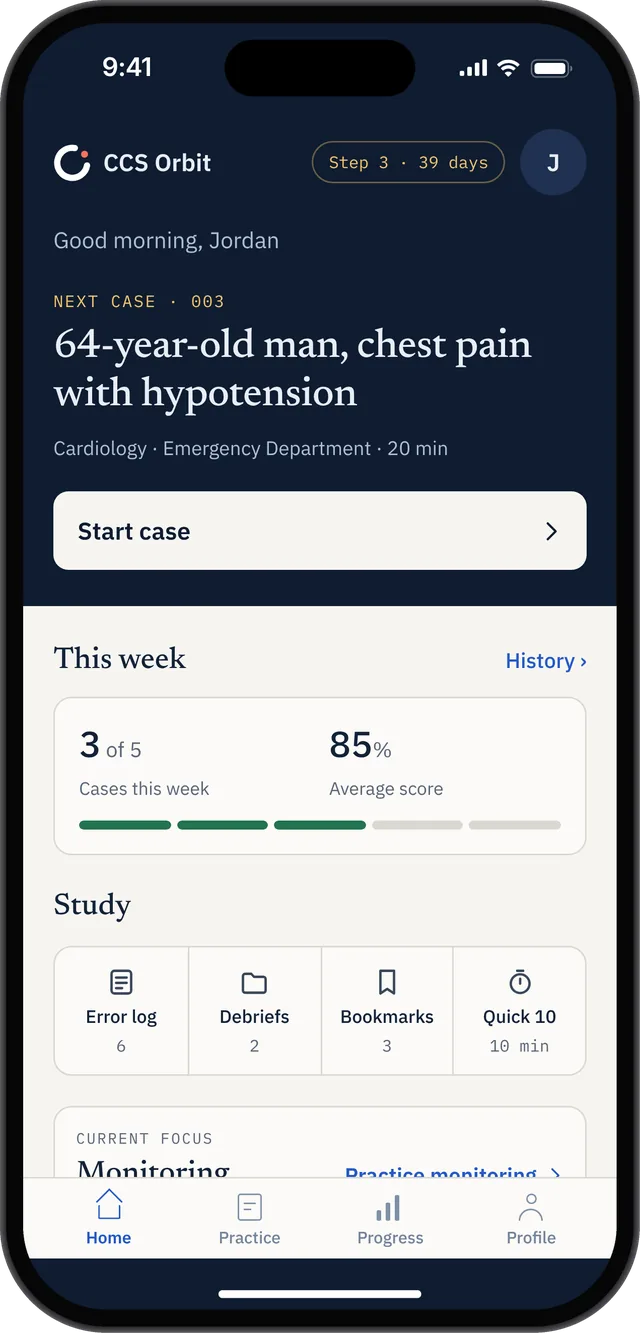
Keep official software practice in your schedule alongside whichever educational resource you choose. CCS Orbit’s iPhone interface is designed for mobile learning; it does not reproduce the official exam software.
Use these early sessions to notice what needs attention. Are you spending time finding orders? Forgetting to review updates? Finishing the initial workup without a plan for what comes next?
Those observations will make your weekly target more useful.
Give new cases and repeat cases different jobs
New cases help you explore unfamiliar presentations and test whether your approach works when you do not know the answer in advance.
Repeat cases let you revisit a particular problem. They are especially useful when you can name what the second attempt is meant to improve.
For example, one repeat might focus on completing the management step you omitted. Another might focus on reviewing the response before moving to the next stage. A third might test whether you can manage the case independently after using guidance on your first attempt.
Keep separate counts for unique cases and total attempts. If you completed 20 different cases and repeated eight of them once, you have practiced 20 unique cases across 28 attempts. That distinction makes your coverage easier to understand.
Use our high-yield CCS cases guide to organize your next choices by presentation and setting.
Build your target from the time you actually have
Start with your calendar. Identify study sessions you can realistically protect, including time to read the debrief.
In CCS Orbit, cases have 10-minute or 20-minute limits. Your whole study session may take longer because reviewing the attempt is a separate task. If you have a short break, you could review a previous case or begin a case and use Save and exit to return later. Reserve uninterrupted sessions for practice under a countdown.
The table below shows three possible four-week plans. These are scheduling examples, not validated minimums or passing thresholds. Each assumes you maintain the same target for four weeks and repeat different selected cases once.
| Total attempts each week | New cases each week | Targeted repeats each week | Four-week total |
|---|---|---|---|
| 5 | 3 | 2 | 12 unique cases; 20 attempts |
| 10 | 7 | 3 | 28 unique cases; 40 attempts |
| 15 | 10 | 5 | 40 unique cases; 60 attempts |
Choose a starting workload you can complete with meaningful review. After the first week, adjust it according to your available time, gaps in coverage and unresolved learning needs.
If every session produces a long list of unfamiliar management decisions, allow more time for review. If your recurring issues are becoming less frequent, you may have room to add new cases.
Use three stages to organize your CCS study plan
Stage 1: Establish a workable case routine
Begin by observing how you move through a case. Read the opening information, form a plan, enter orders, review what follows and decide what to do next.
During this stage, slow down enough to understand unfamiliar steps. After each attempt, identify the part of your routine that caused the most difficulty.
CCS Orbit’s Learn mode provides teaching cues and trap warnings during practice. Use that guidance to understand the reasoning, then explain the plan in your own words.
If you need a starting structure, read our complete guide to approaching Step 3 CCS cases.
Stage 2: Broaden coverage and revisit weak decisions
Choose new cases that add variety to your practice. Review the settings and types of presentations you have covered, then look for gaps.
Alongside that broader practice, repeat cases with unresolved issues. Write a one-sentence goal before each repeat: “I will identify the reassessment step before advancing again,” or “I will review why the patient needed a different care location.”
Afterward, check whether you met the goal and whether you can explain it. If you remembered the answer but still cannot explain the decision, keep that topic on your review list.
CCS Orbit’s Decision Profile, Error Log and case history help you inspect patterns across attempts. Focus Mode helps you choose cases targeting a particular domain.
Stage 3: Test your routine independently
Include sessions where you manage cases without in-case teaching cues. CCS Orbit’s Exam mode supports this kind of practice, with feedback available afterward.
Use a mix of unfamiliar cases and selected repeats. Keep reviewing your results, and continue practicing the official software so that your preparation includes its controls and workflow.
Before the next session, choose a manageable goal from your latest debrief. Our guide to understanding Step 3 CCS scoring and practice feedback explains how to make that goal specific.
Use a weekly review to decide what comes next
At the end of each week, spend a few minutes reviewing your practice record. Ask:
- Which presentations and care settings have I covered?
- Which issues appeared in more than one case?
- Which repeat attempts showed that I could explain and apply the correction?
- Which parts of my routine still depend on guidance?
- Have I left time for official software practice and the rest of Step 3 preparation?
Use the answers to choose the next week’s cases. An uncovered presentation may call for a new case. A recurring omission may call for focused review and a repeat. Difficulty with software controls may call for another session using the official materials.
This gives your case count a purpose. Each session responds to something you have identified in your preparation.
Fit CCS practice into your study week with CCS Orbit
CCS Orbit is an iPhone-first app with a launch library of 120+ CCS cases, including 10-minute and 20-minute cases. Three cases are free, and no CCS Orbit account is required. Cases and debriefs work offline, and Save and exit lets you return to a saved attempt.
Orbit Plus offers a one-time 60-day Exam Pass for US$34.99 or lifetime access for US$59.99. Both options provide access to the complete library and paid learning features, with no automatic renewal. Regional prices and applicable taxes appear in the App Store purchase sheet.
CCS Orbit is coming soon on the App Store. Explore the app and sign up for a launch notification.
Frequently asked questions about CCS practice volume
Do I need to finish every case in a CCS question bank?
A complete pass through a library is a useful coverage goal if you have enough time to review it. Decide how much of the library to complete using your schedule, prior preparation and remaining gaps. Completion alone does not establish exam readiness.
Is doing 100 CCS cases enough?
The number alone cannot answer that question. Review how many were unique cases, whether you understood the feedback and whether unresolved mistakes persist in unfamiliar presentations. Treat 100 as a possible planning target rather than a passing threshold.
Should I count repeated cases toward my total?
Yes, count them as practice attempts and track unique cases separately. Repeats contribute to your study time and give you opportunities to test a specific correction.
How many CCS cases should I do each day?
Set a weekly target first, then distribute it around your schedule. For a ten-attempt week, you might plan two attempts on five study days and reserve time after each for review. Adjust the workload if the debriefs need more attention.
Where can I start with free CCS cases?
Start with the official USMLE practice materials. CCS Orbit will also include three free cases at launch. Our free CCS cases guide explains the available practice options.
Sources
- USMLE: Common Questions — Step 3 CCS practice resources, instructional video and sample-case feedback. Reviewed October 11, 2026.
- USMLE: Step 3 Formats & Questions — official CCS overview and practice materials. Reviewed October 11, 2026.
- CCS Orbit: product features, launch availability and pricing. Reviewed October 11, 2026.
The schedules, study stages and review questions are CCS Orbit editorial suggestions. CCS Orbit is an independent educational resource and is not affiliated with or endorsed by USMLE, NBME or FSMB.