
How to Review a CCS Practice Case—and Improve Your Next Attempt
Turn missed actions and timing errors into a focused next-attempt goal, using a practical five-minute debrief routine.
A practice score tells you how an attempt was graded. It does not, by itself, tell you what to practice next. The most useful CCS case review ends with a specific change you can make in another case. This guide gives you a five-minute debrief routine, examples of useful review notes and a way to decide when to repeat a case or move on.
Key takeaways
- Review the decisions behind the result, including what you missed, delayed, ordered unnecessarily or failed to reassess.
- Separate a knowledge gap from an execution problem. They need different kinds of practice.
- Turn the most important finding into one concrete goal for your next attempt.
- Use repeat cases to rehearse that goal, then test it on another presentation.
- Treat practice percentages as feedback from that resource, not a predicted USMLE score.
Why simply reading the answer is not enough
It is easy to finish a case, glance at the correct orders and think, “I knew that.” Sometimes you did know it. The problem was remembering it at the right moment, finding the order, checking the response or completing the plan before the case ended.
Those are different problems. Rereading a treatment summary may help a knowledge gap. It may do little for a habit of advancing time without deciding when to reassess.
A useful review reconstructs the point where your plan became incomplete. You then practice the action that would have changed it. The goal is a transferable clinical habit, rather than memorizing one simulator's answer list.
A five-minute CCS debrief routine
Five minutes is a suggested structure, not a research-derived optimum. Take longer for a safety-critical misunderstanding or an unfamiliar condition.
| Time | Task | What you should leave with |
|---|---|---|
| First minute | Reconstruct your management sequence | A short account of what you did and what happened |
| Second minute | Identify the most important missed, delayed or inappropriate action | One priority error, rather than an unranked list |
| Third minute | Explain why it happened | A knowledge, recognition, execution, timing or follow-through problem |
| Fourth minute | Write a specific next-attempt rule | A cue and an action you can actually rehearse |
| Fifth minute | Choose the next practice task | Repeat, try a related case or review a focused clinical topic |
Minute 1: reconstruct the sequence before reading every explanation
Briefly recall the patient's initial problem, your first treatment decision, the first important result and the point at which you reassessed or changed the plan.
For example: “I treated the breathing problem, waited for results, then moved toward disposition. I did not repeat the relevant respiratory assessment.”
This short reconstruction makes the feedback easier to interpret. It also helps you notice when an order appeared in your attempt but was placed too late to serve its intended purpose.
Minute 2: choose the most important issue
Start with actions that affected immediate safety, appropriate treatment or response assessment. Then review lower-priority omissions and inefficient choices.
A missed urgent intervention and a minor omission should not automatically receive equal study time. Ask which change would most improve your management of another patient with a similar problem.
USMLE describes evaluation of indicated management, timing, sequence and potentially harmful actions. Its sample feedback also includes examples of actions that have no effect on the score. Avoid assuming that every additional order is penalized, or that every plausible order earns credit. [1]
Minute 3: diagnose the learning problem
Use this classification to decide what to do next:
| Problem | What it sounds like | Useful next step |
|---|---|---|
| Knowledge | “I did not know that intervention was needed.” | Review the relevant clinical guidance, then practice applying it |
| Recognition | “I knew the treatment but did not recognize the indication.” | Compare presentations and the clues that distinguish them |
| Order-entry execution | “I knew what I wanted but could not find or configure it.” | Rehearse the order-entry task in the relevant interface |
| Timing or sequence | “I did the right thing after an avoidable delay.” | Rehearse the opening sequence and next reassessment point |
| Follow-through | “I treated the problem but never checked the result.” | Pair treatment with a specific monitoring and reassessment plan |
More than one category may apply. Choose the one that best explains why this attempt went wrong, rather than labeling every error “knowledge.”
Minute 4: write one cue-and-action rule
“Be more careful” is difficult to practice. A useful note tells you what should trigger a particular action.
Compare these examples:
| Vague review note | More useful next-attempt rule |
|---|---|
| “Remember reassessment.” | “When I start treatment, identify what I will recheck and when.” |
| “Stop missing orders.” | “Before advancing time, check that the time-critical intervention is actually entered.” |
| “Do better at discharge.” | “Before deciding on discharge, review stability, unresolved findings and follow-up needs.” |
| “Order fewer tests.” | “For each additional test, identify the clinical question and how the result could change care.” |
| “Read the feedback.” | “Choose one important finding from the debrief and explain why it changes the next attempt.” |
These are study prompts, not universal clinical orders. Adapt them to the case.
Minute 5: choose the next task deliberately
Repeat the same case when you need to rehearse a particular action or sequence. Choose a related case when you want to know whether the lesson transfers to a different presentation. Review a clinical topic first when you cannot explain the indication, contraindication or interpretation behind the feedback.
An immediate repeat can help you practice execution. A later repeat can help you check whether the lesson is still accessible after the answer is less fresh. There is no single repeat interval that suits every learner or problem.
Worked example: a good diagnosis with incomplete follow-through
Imagine a simulated patient treated for a respiratory problem. You recognize the diagnosis and give appropriate initial therapy. The patient reports feeling better, and you continue toward the end of the case. The debrief identifies incomplete reassessment.
A weak review note is: “Repeat the chest examination next time.” A stronger review asks what that examination was meant to establish and how persistent abnormalities would change the plan.
Your next-attempt goal could be:
After treating an acute respiratory problem, review the relevant respiratory findings and oxygenation before deciding that the patient is ready for the next stage of care.
Then practice the full sequence. If the new findings are concerning, respond to them. The aim is not simply to insert an extra click into the previous attempt.
For a detailed explanation of that process, see CCS reassessment: what to check after treatment.
How to use CCS Orbit's debrief
CCS Orbit's case debrief helps connect the result to individual management decisions and domain feedback. Start with the most consequential finding, read the explanation and compare it with what you remember doing.
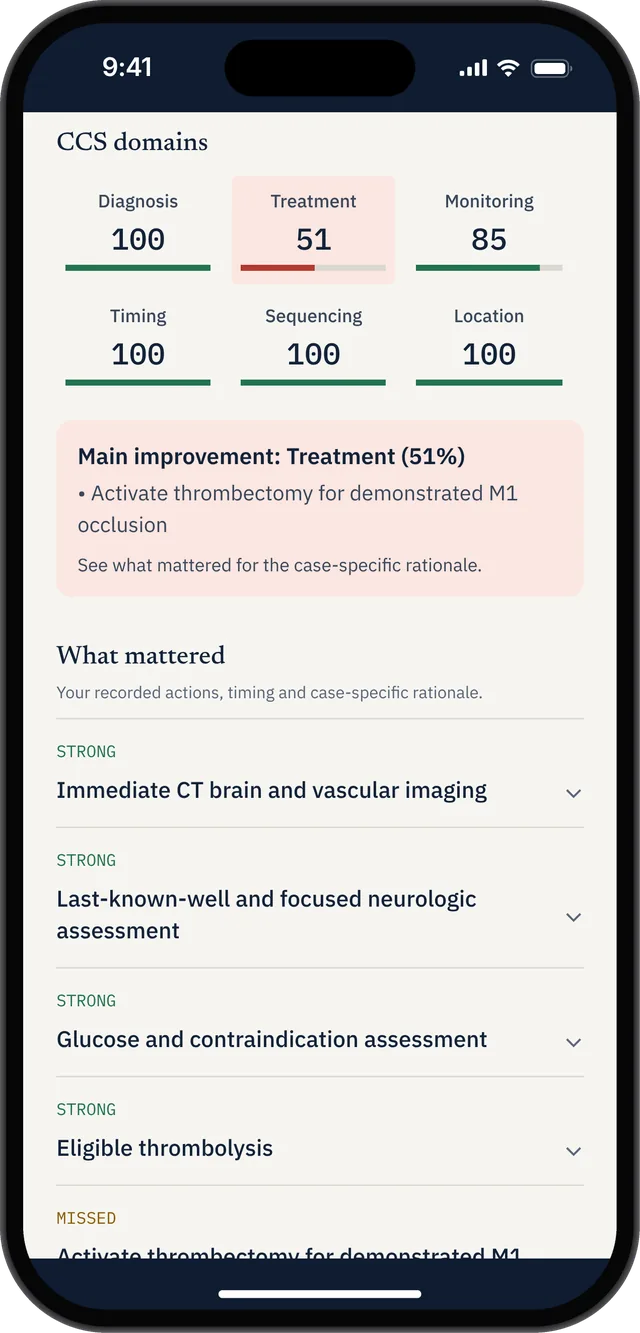
The overall score can help you orient yourself, but the action-level feedback gives you a more useful starting point for the next session. A strong result can still contain a lesson; a weaker result can reveal a specific, fixable pattern.
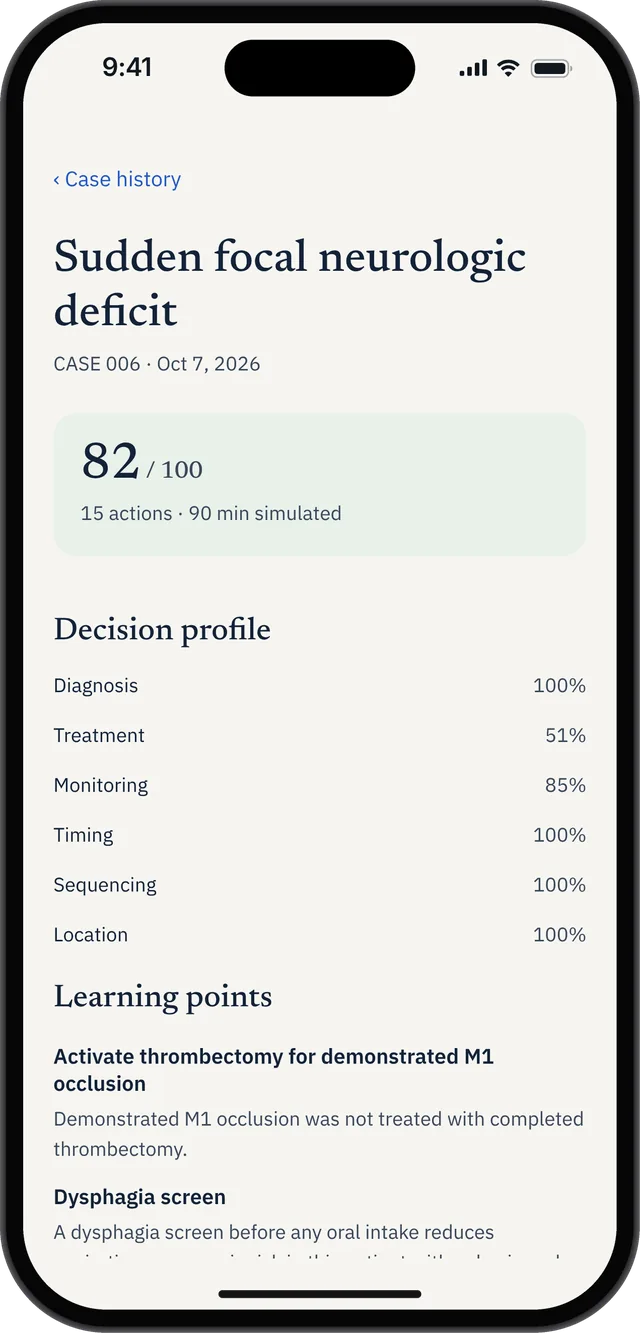
CCS Orbit also includes an Error Log for recurring mistakes, a Decision Profile across six domains and Focus Mode for targeted practice. Use those features to decide where to spend your next session, while checking the underlying case feedback rather than relying on a summary alone.
Track patterns across attempts
One missed action can be an isolated lapse. Repeated difficulty with reassessment, timing or disposition suggests a broader habit worth practicing.
Keep your notes short enough to use. A practical format is:
- Cue: What finding or stage of care should have prompted me?
- Action: What should I have done?
- Reason: Why did it matter in this case?
- Next practice: Which case or skill will I use to rehearse it?
You do not need to create a separate spreadsheet for every attempt. CCS Orbit's saved case history and review tools can support the process; a brief personal note can capture the single lesson you want to remember.
When should you repeat a CCS case?
Repeat when you can name the purpose. “Practice starting the necessary treatment before a large time advance” is a useful purpose. “Get a perfect number” is less informative if you already remember the answer sequence.
After a repeat, ask two questions:
- Did I carry out the intended improvement without prompting?
- Could I explain when the same action would be inappropriate in a different patient?
That second question helps prevent a useful lesson from becoming a dangerous default. The right order still needs the right indication.
When the same case feels automatic, move to a related presentation. Our guide to how many CCS cases to practice discusses balancing coverage with targeted repeats.
Keep practice feedback in context
Commercial platforms provide their own case models and scoring rules. A percentage from one resource should not be treated as interchangeable with another platform's percentage or converted into an official Step 3 score without supporting validation.
Use official materials to understand the examination interface and its examples of management feedback. USMLE recommends practicing the CCS software before the examination and provides sample cases with feedback. [2] Pair that familiarization with the volume and convenience of your chosen practice resource.
If feedback seems to reject a clinically reasonable alternative, review the indication, timing, route and case context. Check a reliable clinical source when needed and use the platform's feedback channel for a possible content issue. The useful outcome is understanding the decision, not memorizing an unexplained exception.
Make the next session small enough to complete
A focused session can consist of one case, a brief debrief and one specific improvement to carry forward. CCS Orbit's offline iPhone practice and save/resume feature make this approach practical when a longer desktop session does not fit your day.
At launch, three cases will be free with no account required. Orbit Plus offers a US$34.99 one-time 60-day Exam Pass or US$59.99 lifetime access, giving you a choice between a focused preparation window and ongoing access. Neither option automatically renews.
See how CCS Orbit works, or use the two-week CCS study plan to organize cases and review sessions.
Frequently asked questions
Do I need to review a case if I scored highly?
A short review can still be useful. Check whether the result reflects a sound management process and whether any important decision was delayed, guessed or difficult to explain.
Should I repeat a case immediately after reading the explanation?
An immediate repeat can rehearse execution. Follow it later with a repeat or a different presentation if you want to check retention and transfer beyond the freshly read answer.
How many mistakes should I work on at once?
Record important findings, especially safety concerns, but choose a manageable priority for the next attempt. One clear behavior is easier to rehearse than a long, unsorted list.
Can I predict my Step 3 score from CCS Orbit results?
CCS Orbit feedback is intended to guide practice. It is not an official Step 3 score prediction or a guarantee of exam performance.
Sources
- USMLE: Computer-based Case Simulations, performance evaluation and sample-case feedback.
- USMLE: Step 3 Formats and Questions, official CCS practice resources.
The five-minute routine is CCS Orbit's suggested study framework. Sources checked October 17, 2026.