
Step 3 CCS Scoring: What Matters Beyond the Diagnosis
Understand what official CCS scoring guidance tells you, then use your practice debrief to improve the decisions behind your result.
You finish a CCS practice case, open the feedback and see a result below what you expected. You recognized the diagnosis. You ordered treatment. So what should you change before the next attempt?
Understanding Step 3 CCS scoring gives you a starting point. Reviewing the decisions behind your practice result gives you something to work on.
The practical answer is that CCS assesses patient management over time. Appropriate actions, their timing and sequence, and potentially harmful decisions all contribute to the official evaluation. A correct action can receive no credit if it comes too late or in the wrong sequence. Multiple acceptable management approaches can exist.[1]
For your preparation, that makes the debrief a useful part of every case. It is where you turn a result into a specific change in how you manage the next patient.
What official CCS scoring guidance tells you
USMLE describes case-specific assessment criteria based on expert physician input. Unnecessary, excessive or potentially risky actions can lower performance; appropriate restraint can matter too. The official guidance provides examples rather than a universal points list for every order.[1]
That is enough to guide a sensible study habit: read the case explanation, identify the relevant decisions and review how you reached them.
Avoid building your preparation around a supposed universal order bundle. Instead, use feedback to ask why an action belonged in this patient’s plan and what information should have triggered it.
If you are still building your workflow, begin with our guide to approaching USMLE Step 3 CCS cases. Then use the framework below to review individual attempts.
Read your practice feedback in six parts
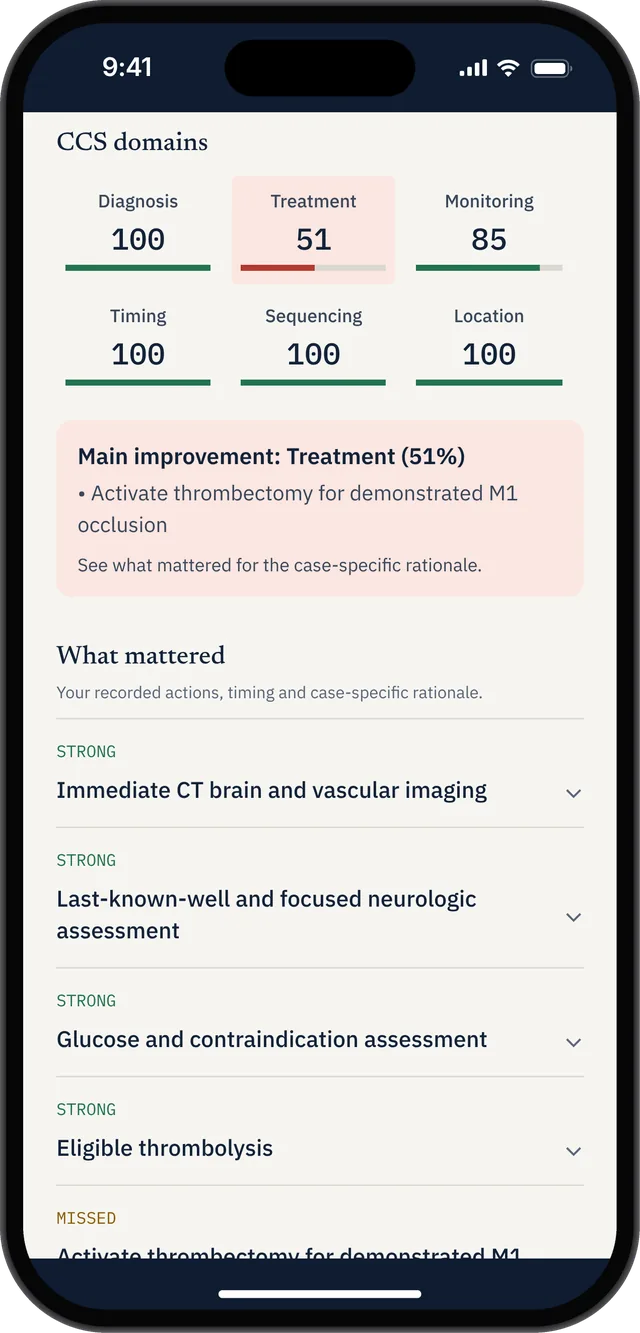
CCS Orbit organizes learning feedback across Diagnosis, Treatment, Monitoring, Timing, Sequencing and Location. The domains assessed depend on the case. These categories provide a way to examine your attempt; CCS Orbit uses its own educational rubric and does not reproduce official USMLE scoring.
| Feedback domain | Question to ask during your review | A useful next practice goal |
|---|---|---|
| Diagnosis | Which finding or result should have changed my working diagnosis? | Connect each important investigation to a decision. |
| Therapy | Did I complete the management step identified in the explanation? | Rehearse the relevant treatment pathway. |
| Monitoring | What did I need to check after acting? | State the reassessment plan before moving on. |
| Timing | When did I recognize the need to act? | Identify the earliest cue for that action. |
| Sequencing | Which decision depended on an earlier step? | Explain the order of your management plan. |
| Location | What care setting did the patient need at that stage? | Review the reason for each transfer or disposition. |
Use the questions to make your review more precise. “I need to improve monitoring” is a broad goal. “I need to decide what response I will check after the first treatment” is a habit you can rehearse.
Separate a missing decision from a delayed decision
When reviewing an attempt, distinguish between something you never considered and something you considered at the wrong moment. Each calls for a different kind of practice.
A missing decision may reveal a knowledge gap. Revisit the explanation, understand the indication and write down the cue that should bring the action to mind.
A delayed decision may reveal a workflow problem. Reconstruct the timeline and identify what occupied your attention before you acted. Perhaps you kept searching for another order, reviewed the same information repeatedly or moved on without completing your plan.
An incorrect sequence deserves its own review. Ask what you needed to establish before taking the next step, and which part of that relationship you overlooked.
For example, imagine a practice debrief identifies a missed reassessment after initial management. Your review could produce a simple rule: before advancing again, say what you expect to change and what you will check. On the repeat attempt, concentrate on using that rule independently.
Our guide to common CCS timing and sequencing mistakes can help you examine these workflow habits in more detail.
Use a five-minute debrief routine
The following is a suggested study routine. Adjust the time when a case exposes a larger knowledge gap.
- Choose one consequential issue. Start with a decision that changed your management plan or appeared repeatedly in previous attempts.
- Find its trigger. Identify the symptom, finding, result or patient update that should have prompted you to act.
- Explain the action. Write one sentence describing why it was relevant in that case.
- Choose a repeatable habit. Make the next practice goal small enough to remember while managing a patient.
- Test it again. Repeat the case later, then try a different presentation that requires the same skill.
A useful note might read: “When a new result returns, I will decide whether it changes the diagnosis, treatment, monitoring or location before entering another order.”
That note gives you a clear purpose for the next session. Keep it visible during guided practice, then put it away when you test yourself without cues.
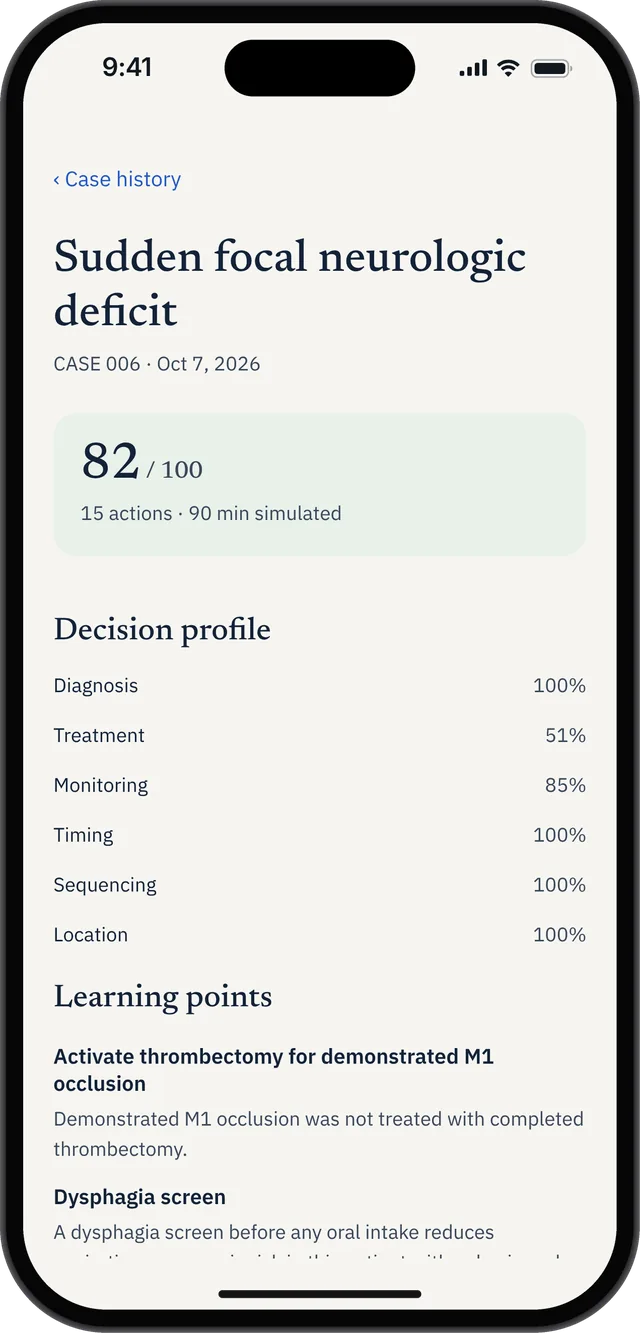
A saved attempt shows the domain breakdown and learning points alongside its overall result.
Treat a repeat score as one part of the evidence
Repeating a case is valuable, but familiarity changes the task. You may remember the diagnosis, order sequence or patient updates from your earlier attempt.
After a repeat, ask whether you can explain your decisions without reopening the answer. Then try an unfamiliar case that makes you use the same habit.
For instance, if your practice goal was to plan reassessment, look for another case where you must review the response to management. This helps you examine whether the habit carries into a different situation.
You can use CCS Orbit’s case history to revisit earlier attempts, the Error Log to review recurring issues and Focus Mode to select cases targeting a chosen domain. The Decision Profile provides another view of patterns across your practice.
Practice with feedback that gives you a next step
CCS Orbit is designed for iPhone, with a launch library of 120+ cases and three free cases. Learn mode provides teaching cues and trap warnings; Exam mode suppresses those in-case cues so you can work independently and review feedback afterward. Cases and debriefs work offline.
Orbit Plus offers a one-time 60-day Exam Pass for US$34.99 or lifetime access for US$59.99. Neither option renews automatically. Regional pricing and applicable taxes appear in the App Store purchase sheet.
CCS Orbit is coming soon on the App Store. Explore the app and sign up for a launch notification.
Frequently asked questions about CCS scoring
What percentage of my Step 3 score comes from CCS?
USMLE states that case-simulation performance affects your Step 3 score and can affect whether you pass. Its proportional contribution is no greater than the proportion of time allotted to CCS. This statement gives an upper limit, rather than one fixed percentage.[2]
Does a case ending early mean I performed well?
An early ending alone does not establish good or poor performance. USMLE says reaching the case-end screen before you expected does not necessarily indicate either.[1]
What CCS practice score do I need to pass Step 3?
CCS Orbit’s practice scores do not predict an official examination result. Use them to identify learning needs and review progress within the app. Avoid treating a particular practice percentage as a passing guarantee.
Can unnecessary orders reduce my CCS score?
Yes. Official guidance identifies unnecessary, excessive and potentially harmful management as possible reasons for lower performance. The significance depends on the case.[1]
Should I add every counseling order at the end?
Choose counseling that is relevant to the patient. USMLE notes that counseling and similar orders generally have little or no scoring weight unless particularly relevant to the case.[1] See our final two-minute CCS checklist for a structured closing review.
How should I decide which cases to repeat?
Choose cases that exposed a meaningful omission, a workflow problem or a recurring issue. Give each repeat a clear learning goal. Our guide to how many CCS cases to practice before Step 3 develops this approach into a study plan.
Sources
- USMLE: Step 3 Formats & Questions — Evaluative Objectives and Assessment of Your Performance, case-end instructions and sample CCS feedback. Reviewed October 11, 2026.
- USMLE: Bulletin of Information — Scoring & Score Reporting. Reviewed October 11, 2026.
- CCS Orbit: product features, launch availability and pricing. Reviewed October 11, 2026.
Study routines and review examples in this article are CCS Orbit editorial suggestions. CCS Orbit is an independent educational resource and is not affiliated with or endorsed by USMLE, NBME or FSMB.