
High-Yield Step 3 CCS Cases: Practice by Presentation and Setting
A case practice list for Step 3 CCS, organized by emergency, inpatient, office, pediatric, obstetric, and psychiatric presentations.
You can't predict which 13 or 14 cases you'll get on Day 2. You can learn the high-yield CCS cases: presentations worth practicing because they test the things CCS is built to score. That means speed when the patient is dying, restraint when they aren't, and the boring orders everyone forgets.
This page is a working list of a broad selection of them, grouped by where you'll meet them. For each presentation, we show a management priority and a common pitfall. These are study prompts, not a prediction of actual exam cases or USMLE scoring weights.
About this list: These are illustrative presentations and management prompts. USMLE does not publish a list of cases or case-specific scoring rubrics. Clinical decisions depend on the complete presentation.
What makes a CCS case useful for practice?
A useful practice case tests several management decisions: diagnosis, treatment, monitoring, timing and sequencing, location, and case-end management. A good practice set includes both urgent and routine care.
Three patterns come up again and again:
- The clock case. Something has to happen promptly: epinephrine in anaphylaxis, calcium in hyperkalemia, decompression in tension pneumothorax. Timing and sequencing carry most of the points.
- The restraint case. The right move is to do less: no imaging for simple back pain, no antibiotics for a breast mass, no bed rest after a fragility fracture. USMLE says aggressive management is scored lower when observation is the standard of care.
- The follow-up case. An office case that runs over weeks or months. The points are in the repeat test, the vaccine or the referral at the follow-up visit, which most people forget because the patient already feels better.
Can you tell which pattern a case is from its opening screen? Getting good at that is half of CCS.
How to use this list
Don't memorize it. Use it to find gaps.
- Read one section and cover the right-hand columns.
- For each case, say your first five orders out loud, in order, before you look.
- Any case where your sequence differs from the "management priority" column goes on a practice list.
- Run those cases as full timed simulations, not as flashcards. Knowing the answer and placing it under a clock are different skills.
Emergency department cases: early decisions matter
These are the cases where a correct plan placed late still loses marks. Act promptly when the presentation calls for it. USMLE does not publish case-specific minute targets or rubrics.
| Case | Management priority | Common pitfall |
|---|---|---|
| Tension pneumothorax | Immediate decompression, then definitive pleural drainage, without delaying for imaging | Ordering a chest X-ray or CT while the patient is still in extremis |
| STEMI with signs of shock | ECG, aspirin, anticoagulation and the cath lab promptly | Nitroglycerin or a beta-blocker in a hypotensive patient |
| Anaphylaxis | IM epinephrine first, then fluids and airway support | Antihistamines or steroids instead of epinephrine, or a beta-blocker |
| hyperkalemia with ECG changes | IV calcium promptly when ECG changes are present, followed by potassium-shifting therapy with dextrose, a cardiac monitor and a plan for removal | Delaying calcium in a patient with ECG changes; giving potassium in hyperkalemia |
| Septic shock (urinary source) | Blood cultures, then antibiotics and fluids promptly, then norepinephrine if still hypotensive | Letting the culture delay the antibiotic |
| Convulsive status epilepticus | Benzodiazepine promptly, bedside glucose, then second-line loading | Sending the patient to CT before the seizure is treated |
| Acute ischemic stroke | CT and CT angiography, assess reperfusion eligibility, then appropriate treatment, plus thrombectomy for a large-vessel occlusion | Thrombolysis before BP is controlled or before CT is back |
| Bacterial meningitis | Prompt empiric antibiotics; dexamethasone when indicated, and CT before LP when indicated | Holding antibiotics until after the LP |
| Severe asthma | Albuterol promptly, systemic steroid, ipratropium, then reassess | Delaying escalation in impending respiratory failure |
| Upper GI bleed | Large-bore access, transfusion, IV PPI, then endoscopy once resuscitated | CT before transfusion. Endoscopy before resuscitation |
| Ruptured ectopic pregnancy | Resuscitate and get the patient to operating room promptly | Methotrexate in an unstable patient |
| Type A aortic dissection | CT angiography, cardiothoracic surgery, beta-blocker before any vasodilator | Thrombolytics. Vasodilator before rate control |
| Adrenal crisis | IV hydrocortisone promptly, fluids, glucose | Waiting for a cortisol level before treating |
| DKA | Fluids first, check potassium, then insulin, then dextrose as glucose falls | Starting insulin before the potassium is known |
| Pulmonary embolism (stable) | CT pulmonary angiogram, bleeding-risk history, then anticoagulation | Thrombolysis for a hemodynamically stable PE |
| Testicular torsion | Urology and surgical exploration first | Waiting for a Doppler ultrasound |
| Necrotising soft-tissue infection | Surgery, broad antibiotics and resuscitation promptly | Delaying surgery for a CT |
| Acute limb ischemia | Vascular surgery and IV heparin | Discharging for an outpatient scan |
| Compartment syndrome | Remove the cast, call orthopaedics, fasciotomy | Elevating the limb |
| Cauda equina syndrome | Emergency MRI and neurosurgery promptly | Discharging before decompression |
| Giant cell arteritis with visual symptoms | High-dose steroid immediately, then biopsy | Waiting for the biopsy before treating |
| Thyroid storm | Thionamide, beta-blocker and hydrocortisone, then iodine at least an hour after the thionamide | Iodine too early. Aspirin for fever |
| Severe symptomatic hyponatremia | 3% saline bolus with a correction-rate limit and serial sodium | Treating without assessing symptoms and cause |
| Malignant hyperthermia | Stop the triggers, give dantrolene promptly, 100% oxygen | Treating the tachycardia with a calcium-channel blocker |
For an example of urgent-order sequencing, see the first five CCS orders.
Toxicology: know the antidote, and the one to avoid
| Case | Management priority | Common pitfall |
|---|---|---|
| Acetaminophen overdose | Timed level, N-acetylcysteine promptly, suicide precautions, psychiatry | Activated charcoal outside its window. Forgetting the safety orders |
| Tricyclic overdose | ECG, then sodium bicarbonate for QRS widening, and airway protection | Physostigmine or flumazenil |
| Benzodiazepine overdose | Airway positioning and ventilatory support, capnography | Routine flumazenil use without considering seizure risk |
| Digoxin toxicity | Assess severity and potassium; give digoxin immune Fab for life-threatening toxicity | Ignoring potassium and the indications for antidote; treatment decisions depend on rhythm and stability |
| Carbon monoxide poisoning | 100% oxygen immediately, then co-oximetry | Discharging on a normal pulse-oximeter reading |
| Serotonin syndrome | Stop serotonergic drugs, benzodiazepine, cooling | Haloperidol. Physical restraints |
| Neuroleptic malignant syndrome | Stop the antipsychotic, cooling, fluids, ICU | Restarting an antipsychotic |
| Opioid use disorder after overdose | Withdrawal score before buprenorphine, offer naloxone and addiction follow-up | Benzodiazepines |
High-yield CCS cases on the ward
Inpatient cases usually test monitoring and sequencing more than raw speed.
| Case | Management priority | Common pitfall |
|---|---|---|
| Post-operative fever (catheter-associated UTI) | Urine culture before antibiotics, remove the catheter | Leaving an unnecessary catheter in place |
| Alcohol withdrawal and delirium tremens | Symptom-guided benzodiazepine, thiamine, magnesium, ICU if severe | Haloperidol or restraints before a benzodiazepine |
| Delirium in an older adult | Medication review, stop anticholinergics, hydrate, reorient | Benzodiazepines for agitation |
| Hip fracture after a fall | Nerve block, early fixation, VTE prophylaxis, delirium screening | Prolonged bed rest or traction |
| Refeeding syndrome | Thiamine before calories, replace phosphate, potassium and magnesium, slow reintroduction | Full-rate feeding from day one |
| Contrast-associated AKI | Stop nephrotoxins and metformin, volume assessment, repeat chemistry | Reflexively giving diuretics or repeating contrast without an indication |
Office and follow-up cases: where the easy points hide
These feel slow and low-stakes. They're where well-prepared candidates quietly lose points, because the management decisions come at the follow-up visit.
| Case | Management priority | Common pitfall |
|---|---|---|
| New type 2 diabetes | Confirm with HbA1c, check renal function, start metformin, repeat HbA1c at about three months | An insulin infusion for a stable outpatient |
| Primary hypothyroidism | TSH and free T4, levothyroxine, repeat TSH at six to eight weeks | Methimazole |
| Stage 2 hypertension | Confirm with home or ambulatory readings, two agents, recheck electrolytes | IV antihypertensives for asymptomatic high blood pressure |
| Iron-deficiency anemia (postmenopausal) | Iron studies, oral iron, colonoscopy and upper endoscopy | Transfusing a stable patient |
| Postmenopausal bleeding | Endometrial evaluation and follow-up of pathology as indicated | Starting estrogen |
| Palpable breast mass | Diagnostic imaging, then core-needle biopsy, then follow up the result | Antibiotics for a solid mass |
| Osteoporosis after fragility fracture | DXA, calcium and vitamin D, renal function before alendronate, falls prevention | Bed rest |
| Shingles | Antiviral, pain control, zoster vaccine at follow-up | Forgetting the vaccine |
| Nonpurulent cellulitis | Oral antistaphylococcal antibiotic, reassessment and supportive care | Incision and drainage with nothing to drain |
| Acute gout | Appropriate anti-inflammatory therapy after assessing comorbidities | Aspirin |
| Pelvic inflammatory disease | Pregnancy test, ceftriaxone plus doxycycline plus metronidazole, partner services | Skipping the pregnancy test |
| Proximal DVT | Compression ultrasound, then a DOAC and counseling | An IVC filter. Thrombolysis |
| Latent TB | Chest X-ray to exclude active disease, then a short-course regimen | Starting treatment before excluding active TB |
| Low-back pain without red flags | Red-flag screen, stay active, heat | Strict bed rest. Imaging without an indication |
| Suspected sleep apnoea | Sleep study before CPAP, drowsy-driving counseling | Diagnosing from a questionnaire alone |
| Secondary syphilis | Benzathine penicillin G, HIV testing, partner services, repeat RPR | Forgetting the follow-up titer |
Tip: in any office case, before you send the patient home, ask yourself what should happen at the next visit. If the answer is a test, a vaccine or a referral, order it or schedule it.
Pediatrics: weight-based, parent-facing, often observed
| Case | Management priority | Common pitfall |
|---|---|---|
| Severe croup | nebulized epinephrine promptly, dexamethasone, then observe | Sedation. Discharge before the observation period |
| Bronchiolitis | Supportive care: oxygen if hypoxic, hydration, suction | Codeine. Treating it like asthma |
| Gastroenteritis with dehydration | Oral rehydration first, IV only if needed, then reassess | Loperamide |
| Febrile young infant | Age- and risk-based evaluation, empiric antibiotics and admission when indicated | Discharging an infant who hasn't been fully worked up |
| Early-onset neonatal sepsis | Blood culture and age-appropriate empiric antibiotics promptly | Ceftriaxone in a neonate |
| Intussusception | Ultrasound, then air or contrast enema reduction | Laxatives |
| Neonatal jaundice | Serum bilirubin, then phototherapy above threshold, feeding support | Starting phototherapy without a level |
| Acute otitis media | Otoscopy, amoxicillin, analgesia | Aspirin in a child |
| Suspected physical abuse | Skeletal survey, report, protective placement | Discharging to the same caregiver |
| Six-month well-child visit | Growth, developmental screening, vaccines, anticipatory guidance | Skipping the development screen |
Obstetrics and gynecology
| Case | Management priority | Common pitfall |
|---|---|---|
| Preeclampsia with severe features | antihypertensive promptly, magnesium, obstetrics | An ACE inhibitor in pregnancy |
| HELLP syndrome | Magnesium, blood-pressure control, delivery planning | NSAIDs for pain |
| Postpartum hemorrhage (atony) | Uterine massage, oxytocin, tranexamic acid, blood | Waiting to see if it settles |
| Ovarian torsion | gynecology and urgent laparoscopy to untwist and preserve the ovary | Waiting for Doppler flow to rule it out. Normal flow doesn't exclude torsion |
| Hyperemesis gravidarum | IV fluids, antiemetic, thiamine before dextrose | Dextrose before thiamine |
Psychiatry and social cases: location of care is the test
| Case | Management priority | Common pitfall |
|---|---|---|
| Acute mania | De-escalation, antipsychotic, psychiatry, admission | An SSRI |
| Depression with suicidal intent | One-to-one observation promptly, means restriction, psychiatric handover | Letting the patient leave |
| Intimate partner violence | Interview the patient alone, danger assessment, safety plan | Interviewing with the partner present |
| Elder neglect | Private interview, capacity, Adult Protective Services, safe placement | Discharging to the same situation |
Patterns across the list
Look down the trap columns and the same mistakes keep appearing:
- Imaging before stabilization. CT before decompression, Doppler before surgery, MRI before the seizure stops.
- Treating the number instead of the patient. Discharging carbon monoxide poisoning on a normal saturation reading.
- The right drug in the wrong order. Insulin before calcium, iodine before the thionamide, a vasodilator before the beta-blocker.
- Forgetting the follow-up. The repeat HbA1c, the zoster vaccine, the RPR titer.
The common CCS mistakes article covers each of timing errors in more depth, and the CCS order cheat sheet groups the orders themselves by category.
Practice these decisions
CCS Orbit brings 120+ interactive cases to iPhone at launch, with Learn and Exam modes, six-domain debriefs and review tools for recurring mistakes. Cases and debriefs work offline. Three cases are free; Orbit Plus offers a one-time US$34.99 60-day Exam Pass or US$59.99 lifetime access. Explore the app and get its launch email.
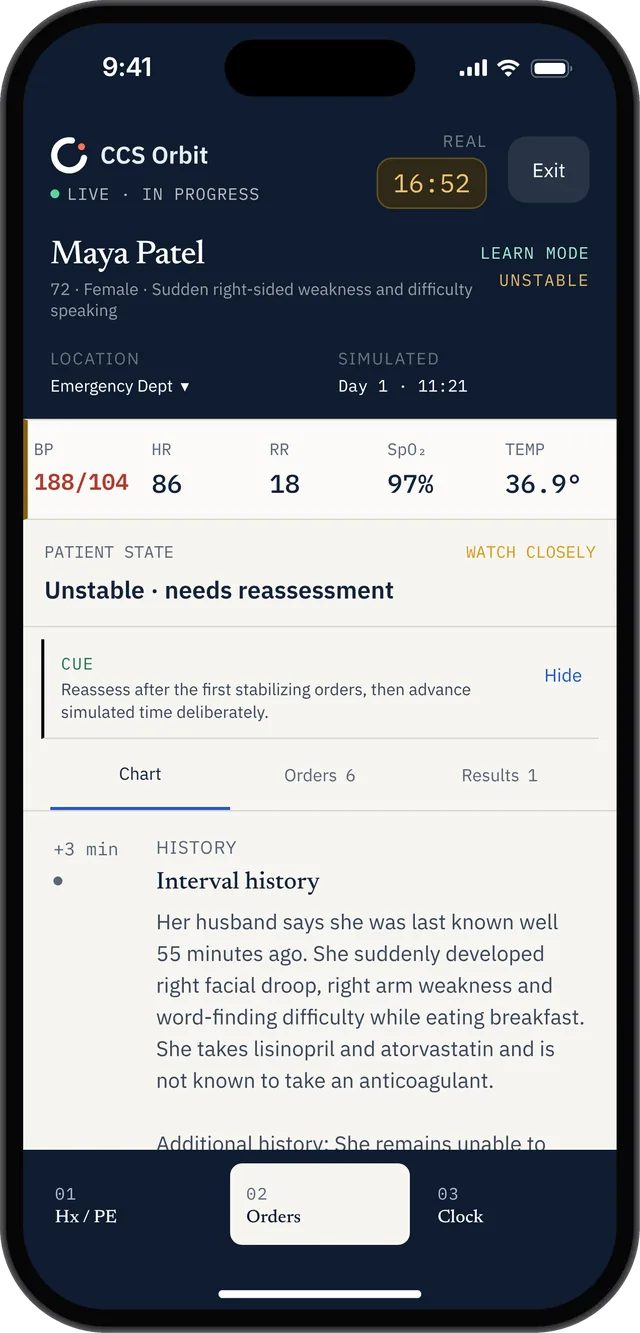
Practice the patient’s workup, treatment and reassessment rather than stopping at recognition of the diagnosis.
Key takeaways
The high-yield CCS cases are the ones that test timing, restraint and follow-up, and most of them fall into a few patterns: stabilize before you image, give treatments in the right order, and schedule what should happen at the next visit. Use this list to find the cases where your instinctive sequence is wrong, then fix them with full, timed simulations rather than rereading.
Frequently asked questions
What are useful CCS practice cases for Step 3?
The most high-yield CCS cases test timing and sequencing under pressure: tension pneumothorax, anaphylaxis, hyperkalemia with ECG changes, septic shock, status epilepticus, stroke and meningitis. Office follow-up cases, such as new diabetes, hypertension and iron-deficiency anemia, are equally important because their points are easy to miss.
How many CCS cases are on Step 3?
Day 2 of Step 3 includes 13 to 14 CCS cases, each with a maximum of 10 or 20 minutes of real time, after 180 multiple-choice questions. The cases are drawn from across the Step 3 content outline, so you can't predict which ones you'll get.
Should I memorize a CCS case list?
No. Use a case list to find presentations where your instinctive order sequence is wrong, then practice those as full timed simulations. CCS scores what you do and when, so knowing the answer isn't enough if you can't place the orders in the right sequence under a clock.
Are CCS cases mostly emergencies?
No. CCS cases are set in the office, the emergency department, the ward and the ICU, and some run over weeks or months of simulated time. Outpatient and follow-up cases are common, and they're often where candidates lose points by forgetting repeat tests, vaccines or referrals.
What is the common mistake in CCS cases?
One of the most frequent patterns is ordering tests or imaging before stabilising the patient, for example a chest X-ray before decompressing a tension pneumothorax. Other frequent mistakes are giving the right drugs in the wrong order and forgetting follow-up orders in office cases.