
Step 3 Free 137: How to Use It—and What You Still Need to Practice for CCS
Make your official sample questions count: a practical review routine, current software guidance and a clear plan for the CCS skills they do not test.
The Step 3 Free 137 is a useful starting point for official multiple-choice practice. It can help you identify gaps in your reasoning, review unfamiliar question formats and plan your remaining study. But selecting the next best step from a list is different from managing a patient yourself. This guide explains how to use the questions productively—and how to turn what you learn into purposeful CCS practice with CCS Orbit.
Key takeaways
- Start with the official USMLE resources so you use the right questions and testing software.
- Decide whether your attempt is timed practice or open-book learning, and record those conditions with your result.
- Review uncertain correct answers as well as mistakes. A percentage alone does not tell you what to study next.
- Do not treat a Free 137 percentage as an official passing threshold or a validated three-digit score prediction.
- Practice CCS separately: ordering, sequencing, reassessment and disposition require decisions across an evolving encounter.
What is the Step 3 Free 137?
“Free 137” is the informal name students use for the official 137-question Step 3 sample booklet. USMLE also offers an interactive testing experience. The sample set introduces exam-style questions; it is not a complete rehearsal of both examination days or a substitute for a preparation plan.
The official booklet includes an answer key. If you use a third-party explanation guide, check that it matches your version and question numbering before reviewing. A mismatch can look like a reasoning error when you are simply reading an explanation for a different question.
Where to find the official questions
Use these official starting points:
- USMLE Step 3 sample questions for the sample PDF and linked practice experience.
- USMLE exam resources for the updated Step 3 interactive test and tutorial.
- Step 3 question formats for instructions on question types and software practice.
Check the software, not just the question count. USMLE introduced updated Step 3 software for exams beginning on or after March 10, 2026, including shorter, 30-minute multiple-choice blocks. An older PDF's block layout is not a reliable guide to the current examination interface. Follow the current official tutorial for your administration rather than copying timing instructions from an archived explanation page.
When should you take it?
Choose a point when you have covered enough material to interpret your mistakes and still have time to act on them. For many study plans, that means using it as a checkpoint after substantial preparation, with a separate review session already reserved. There is no single ideal day for everyone.
If you are early in preparation, you can use the questions for learning. Just record that you used references or worked untimed. If you want an independent timed attempt, avoid reading the explanations first. Familiar answers can make a later percentage feel more reassuring than it should.
Use the free Step 3 study planner to reserve assessment and review time around your exam dates and work commitments. Keep CCS practice in the schedule before this checkpoint; do not wait for a multiple-choice result to begin learning case management.
How to take and review the Free 137
1. Set a purpose before you start
For timed practice, use the appropriate official interactive experience and its instructions. Work without looking up answers, and record interruptions or unfinished questions. For learning, pause and research as needed—but label the session as learning rather than comparing its result with an uninterrupted first attempt.
2. Keep a short uncertainty list
Note questions you guessed, changed repeatedly or solved too slowly. A correct answer reached through weak reasoning still deserves review. Avoid writing a second textbook while taking the set; a question number and a few words are enough.
3. Diagnose the mistake
For each missed or uncertain question, choose the main reason you struggled:
| What went wrong | Useful next step |
|---|---|
| Missing factual knowledge | Review that concept and explain it from memory |
| Missed a decisive clue | Write which finding should have changed your interpretation |
| Chose the right action at the wrong stage | Explain what must happen before that action |
| Misread the question or answer choices | Identify the wording you overlooked and a reading habit to change |
| Struggled with a calculation or study result | Practice the calculation and its interpretation using the biostatistics tool |
| Ran out of time | Review where time was spent and rehearse pacing in the current interface |
4. Write a rule you can apply again
“Review cardiology” is too broad to guide the next session. A better note describes a decision: “Identify whether this patient is unstable before choosing a definitive investigation.” Then explain which findings would make you act differently. Your note should be useful in a new question, not only in the one you just read.
5. Choose a small number of priorities
Group repeated mistakes and pick two or three targets for the next study sessions. Some need question practice; others need a simulated case. Repeating the entire set immediately may improve recall of its answers without resolving the underlying weakness.
What does your Free 137 score mean?
Your percentage describes performance on that attempt under those conditions. It does not, by itself, establish that you are ready for every component of Step 3. The official sample materials linked here do not provide a validated conversion from percentage correct to a three-digit Step 3 score or an official Free 137 passing cutoff.
Online score reports can be useful context, but people differ in preparation, prior exposure, timing and how they report results. A popular threshold is not a guarantee. Avoid making an exam-date decision from a single percentage: consider your broader assessment evidence, remaining gaps and ability to complete the relevant exam tasks.
A repeat attempt can still help with learning. Record it as a repeat, however, because recognition makes it a different measure from your first attempt.
What the Free 137 does not test about CCS
The sample booklet does not include the computer-based case simulation format. In a multiple-choice question, the options help define the decision. In CCS, you must generate a plan, carry it out and respond as the encounter unfolds. That is why strong multiple-choice performance and unfinished CCS preparation can coexist.
| Multiple-choice practice helps you rehearse | A CCS case adds |
|---|---|
| Recognizing an appropriate next step | Entering the needed orders yourself |
| Interpreting a set of supplied results | Deciding which results to obtain and when to review them |
| Choosing treatment from listed options | Coordinating treatment, monitoring and subsequent decisions |
| Identifying a likely response | Checking whether the patient actually improved |
| Selecting a suitable care setting | Managing location and disposition within the encounter |
Use the official CCS practice software to learn the examination controls. Use CCS Orbit for repeated patient-management practice and feedback on your decisions. These serve complementary purposes: familiarity with the official interface and a structured way to build your case-management skills.
Turn a missed management question into CCS practice
Here is an original study exercise, not a reproduction of a Free 137 question. Suppose your review shows that you often recognize a diagnosis but hesitate about what follows treatment. Your next task is not simply to memorize another treatment list. Practice closing the management loop:
- Name the immediate problem. What needs attention now, and what information could change your priority?
- Choose treatment and monitoring together. Decide how you will know whether the intervention worked.
- Plan reassessment. What finding or result are you waiting for, and how will risk affect when you check it?
- Respond to the result. Improvement, persistent symptoms and deterioration should not automatically produce the same next action.
- Review the attempt. Identify the first decision you would change, then practice that decision in another case.
For example, if your recurring mistake is assuming that ordering treatment completes management, set a concrete practice target: “After starting treatment, identify the response I need to check before deciding the next step.” Our CCS reassessment guide shows how to develop this habit with worked examples.
Practice the CCS portion with CCS Orbit
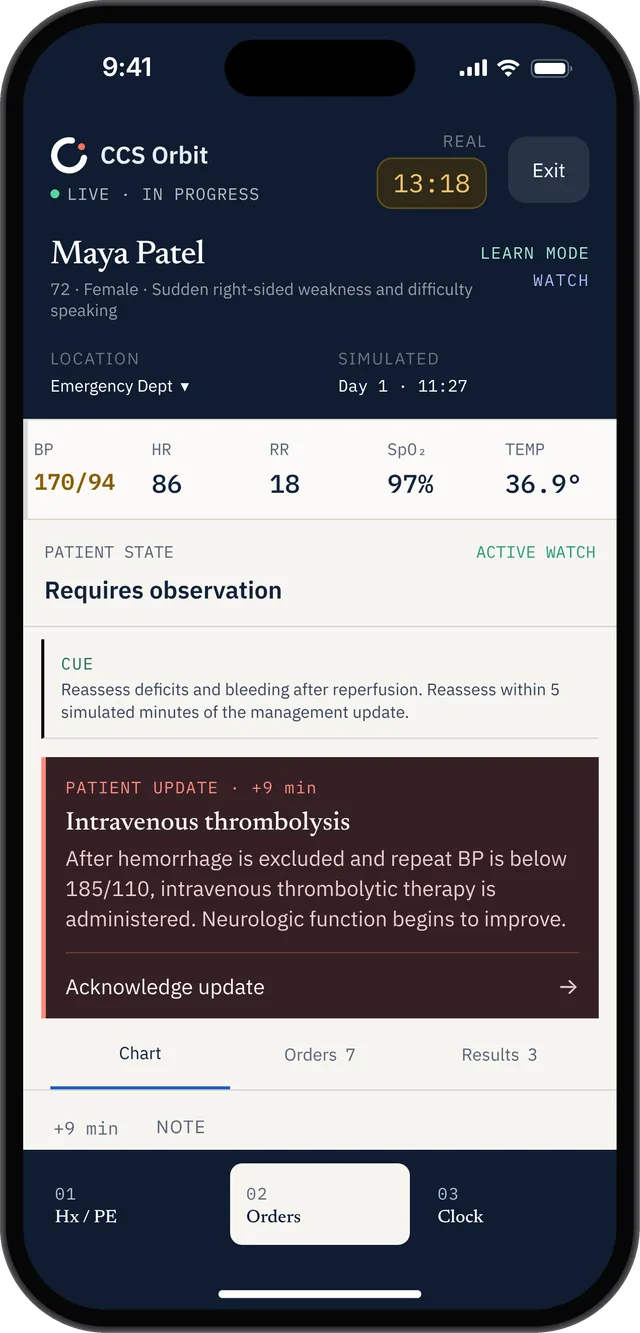
CCS Orbit brings full CCS case practice to iPhone, with 120+ cases at launch, offline cases and debriefs, and Save & exit for interrupted sessions. You can work through patient management, then review feedback across diagnosis, treatment, monitoring, timing, sequencing and location.
The debrief helps you move from “I missed something” to a specific practice goal. Decision Profile, Error Log and Focus Mode support that review across attempts. Orbit's domains are a learning framework, not the official USMLE scoring formula or a predicted examination score.
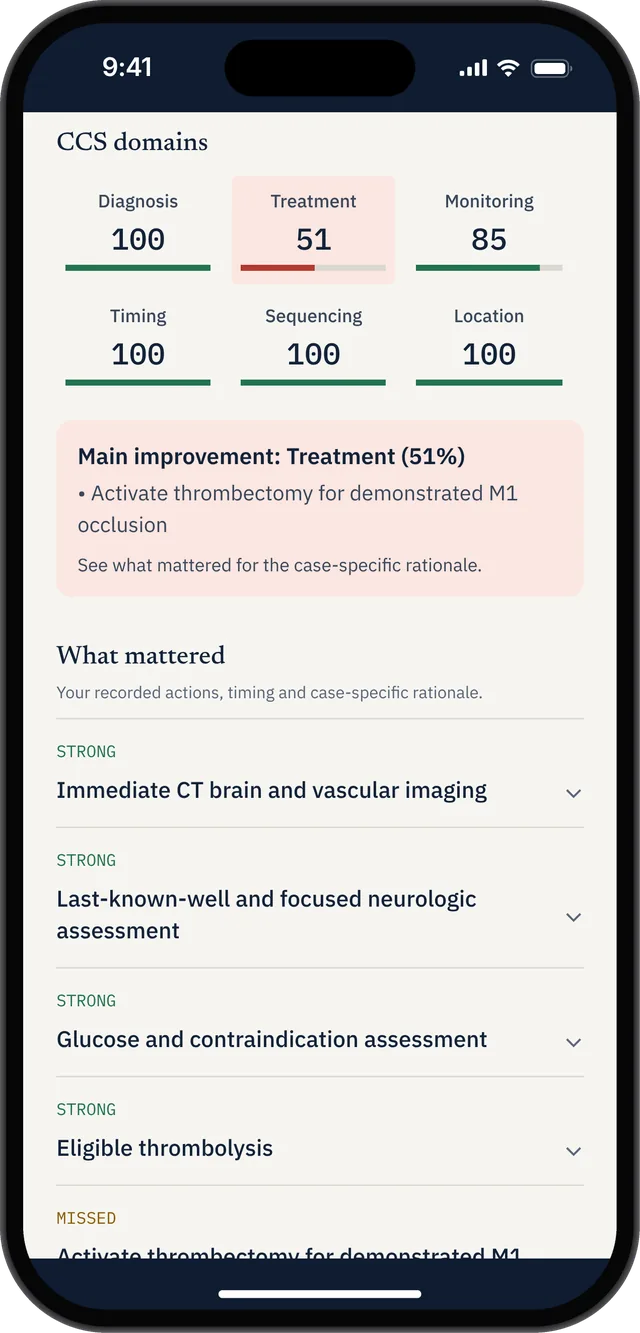
A simple routine is to review one management weakness from your question session, complete a relevant case, and spend five minutes identifying what to change next time. Our case-review guide explains that process in detail. The iPhone walkthrough shows how case practice, saved attempts and feedback fit together.
CCS Orbit is coming soon to the App Store. At launch, start with three complete free cases, then choose the US$34.99 non-renewing 60-day Exam Pass or US$59.99 lifetime access for the full library. See the plans or get notified at launch. You do not need a second paid CCS case bank to use Orbit alongside the free official software.
Frequently asked questions
Is the Free 137 the same as a paid NBME self-assessment?
No. It is the informal name for the free official sample-question set. Do not assume it has the same reporting or predictive properties as a separately purchased self-assessment.
Does the Free 137 include CCS cases?
The 137-question sample booklet is multiple choice and does not contain the CCS simulation format. Practice official CCS cases separately and build patient-management experience through full case attempts.
Should I do the old or new Free 137?
Start from the current official USMLE resource pages. If you also use archived sets, match explanations to the specific version and record prior exposure. Older question sets do not replace practice with the current test interface.
Is there a percentage that guarantees passing Step 3?
No Free 137 percentage should be treated as a guarantee. Use your result to identify weaknesses, alongside broader preparation evidence. It does not assess your ability to run a CCS encounter.
Can I repeat it?
Yes, for review and learning. Keep repeat results separate from your first attempt and check that you can explain the reasoning rather than recognize the answer.
Sources and further reading
Official resources checked October 17, 2026. The review routine and study exercises above are CCS Orbit's educational suggestions.