
Free CCS Cases: Where to Practice Without Paying
There is more free CCS practice available than most candidates use — starting with the official cases from the people who write the exam. What is genuinely free, and how far it gets you.
You can begin CCS preparation without buying a subscription. The official practice software helps you learn the exam interface, while Orbit’s three free cases at launch provide a complete iPhone management-and-review experience.
This is a straight inventory of what you can practice without paying, in the order you should use it, and an honest account of where free practice stops being enough.
In this article
Start here: the official practice cases
The USMLE program publishes practice CCS cases through its interactive testing experience. Per the official Primum CCS materials, you can practice with six CCS cases and receive case-related feedback at no cost.
Six cases and feedback, from the organization that writes the exam, is the single most valuable free resource in this entire category — and it is not close.
Why it matters more than the case count suggests. Every commercial product approximates the CCS interface. These cases are the interface: the actual order sheet, the actual three-character order matching, the actual confirmation prompts and route selection, the actual mechanism for advancing simulated time, and the actual case-end instructions screen with its restrictions. On test day the six-minute CCS tutorial assumes you already know all of this. That familiarity is available for free, and it converts directly into real-time budget on the exam.
Use the current Step 3 interactive testing experience linked from USMLE’s Step 3 materials page. Exams beginning on or after March 10, 2026 use the updated software; older tutorials may show different controls.
Do these six cases twice: once early, to learn where everything is, and once close to your test date, to confirm the mechanics are still automatic. Nothing else on this page is a better use of a free hour.
The official case walkthrough
The USMLE also publishes a demonstration of a physician running a complete CCS case, available as a video with a published transcript.
Watch the demonstration and take notes on the interface controls, rather than assuming its running time or using it as a complete clinical study session.
- the case start screen displays your maximum allotted real time
- orders can be typed as a list in one entry rather than one at a time
- the software prompts you to confirm each order and to select a frequency where applicable
- you select a route of administration for medications, and the software optimizes the dose
- simulated time advances by obtaining results or choosing to see the patient later
- location changes are made through a change-location step with a confirmation
- the alert that roughly two minutes of real time remain, and what closes at that point
Watching someone competent run the loop is a different kind of learning from running it yourself. Both are free. Do both.
The CCS tutorial and sample questions
Two smaller free resources round out the official material.
The exam's own CCS tutorial appears on test day as a six-minute orientation before the cases. It is short because it assumes familiarity, which is the point — but the official practice materials let you see that orientation content before you are sitting in a test center with a clock running.
Sample test questions. The USMLE publishes more than 100 sample Step 3 multiple-choice items, plus the format explanations for each question type. Not CCS practice, but relevant to the same day, and free.
Free tiers from commercial products
Beyond the official material, several paid products let you try real cases without paying.
CCS Orbit will include three complete free cases at App Store launch, with no CCS Orbit account or card required. Manage the patient from presentation through case end and review the same six-domain debrief available in the paid library. Case history and the Error Log help you carry useful lessons into the next attempt.
CCSCases advertises two free cases. Check the current trial and access terms if you want to compare its browser workflow with Orbit’s three free iPhone cases at launch.
Question banks generally do not offer standalone free CCS access. UWorld sells CCS bundled with its Step 3 question bank, and AMBOSS includes CCS-style clinical scenarios within its Step 3 membership rather than as a free component. Both sometimes run free trials of the broader product; whether CCS content is included in a given trial is worth checking directly rather than assuming.
Free web simulators: how to vet one
A number of free or freemium web-based CCS simulators have appeared, and they vary enormously. Some are useful. Some are thin content wrapped around an aggressive paywall, and a few are built primarily to rank for searches like the one that brought you here.
Free is not the same as harmless: practicing a case whose clinical content is wrong teaches you something you then have to unlearn. Five questions worth asking:
Before you invest hours in a free simulator
- Who wrote and reviewed the clinical content? Look for a stated review process and named clinical involvement, not just a case count on a landing page.
- Is the feedback specific, or just a number? "72%" teaches nothing. "You treated correctly but never reassessed, and the disposition was late" is worth having.
- Does it model time at all? A case that does not make you advance a clock and does not interrupt you near the end is a case script with buttons. Useful for clinical reasoning; useless for timing.
- What is actually free? Complete cases, or the first two screens of a case before a paywall? Check before you build a study plan around it.
- Does it make claims it cannot support? Score predictions, "real exam cases," or implied USMLE affiliation are all signals to close the tab. No third-party product has access to real exam cases, and the official scoring methodology is not published.
A free-first study plan
If budget is the constraint, this sequence extracts most of the available value before you spend anything:
- Watch the official case walkthrough and take notes on mechanics, then practice using the current interface.
- Work through the six official practice cases in the current interactive testing experience. Slowly the first time. Deliberately note where you hesitated.
- Read the official CCS format material and the case-end restrictions, so you know what closes at the two-minute alert before you meet it. Our final two minutes and order entry guides summarize the mechanics with sources.
- Build the free reflexes. Opening sets, the advance-and-reassess loop, the closing sweep. These cost nothing to practice and are what most candidates are actually missing — see the first five orders.
- Use free tiers for volume. Complete the free cases in any product whose content you have vetted, and review your own errors rather than just your scores.
- Then decide whether to pay, and for what. By this point you will know whether your gap is clinical breadth (which argues for a large case bank) or consistency and mechanics (which argues for something you will actually open on a busy day).
Most candidates who feel they must buy a case bank immediately have not yet done steps one through four — which are the steps that determine whether a case bank helps.
Where free practice runs out
Two honest limits.
Six cases is orientation, not volume. The official practice cases teach you the software and the shape of a case. They cannot give you thirteen or fourteen repetitions across varied presentations, which is what Day 2 actually asks for. Repetition is the thing free resources are worst at supplying.
Free tiers are designed to be insufficient. That is not a criticism, it is the model — including ours. A free tier's job is to let you evaluate honestly, and a good one does that. It is not a complete study program, and a product implying otherwise is being less than straight with you.
What free practice can absolutely do is make sure that when you do spend money, you spend it on the right gap. And it can eliminate the specific failure that costs candidates the most on the CCS portion: meeting the interface for the first time on test day.
Free cases, not previews
Try complete cases before deciding anything
At launch, CCS Orbit will include three free cases you can work through end to end—presentation, order entry, clock, closing period and the same six-domain debrief as the paid library. The Error Log groups recurring decisions for review.
It is a supplement rather than a replacement for a full case bank, and it is not a replica of the exam's interface — the official practice cases remain the place to rehearse that. What it is built for is the part that usually breaks down: practicing often enough, on the days when a desktop session was never going to happen.
Three cases are free. Orbit Plus offers a 60-day Exam Pass for US$34.99 or lifetime access for US$59.99. These are the only two paid options. Both are one-time purchases with no automatic renewal or monthly subscription. Regional prices and applicable taxes appear in the App Store purchase sheet. See Orbit Plus options.
Available on the App Store soon. Get one email at launch →
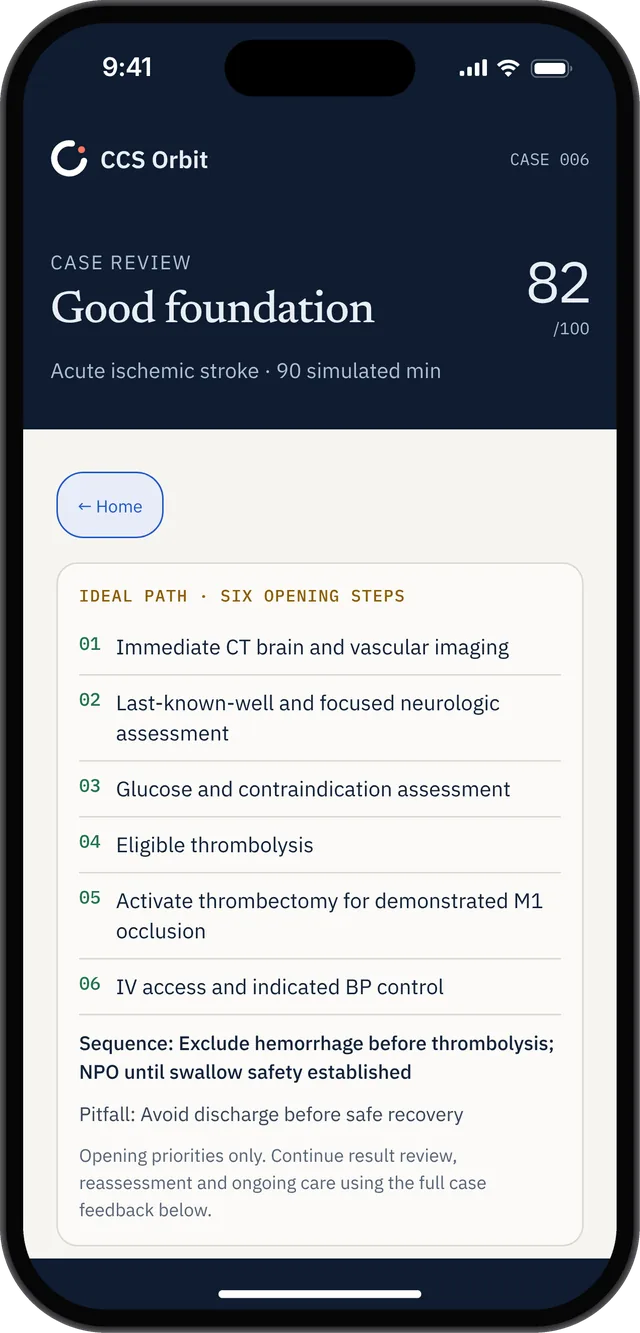
Three cases and their full debriefs are free at launch. The case-review screen summarizes the attempt and opening priorities.
FAQ
Are there free official CCS practice cases?
Yes. The USMLE's own Primum CCS materials describe practicing with six CCS cases and receiving case-related feedback through the interactive testing experience, at no cost. It is the most authentic CCS practice available at any price, because it uses the actual exam software.
How many free CCS cases are there in total?
Six from the official practice materials, plus whatever the free tiers of commercial products include. That is enough to learn the interface and the shape of a case, but not enough to build the volume of repetitions the exam's 13 to 14 cases call for.
Where do I find the official practice cases?
Visit the official USMLE Step 3 materials page and select the current interactive testing experience for exams beginning on or after March 10, 2026.
Can I pass the CCS portion using only free resources?
No study resource, free or paid, can promise an exam outcome, and nobody can tell you what is sufficient for your situation. What is defensible: the free official material is the best available preparation for the exam's mechanics, and mechanics are where a lot of avoidable loss occurs. Clinical breadth across many varied cases is the part free resources supply least well.
Are free CCS simulators any good?
Evaluate free simulators for clinically appropriate content, realistic timing and specific feedback. Verify claims of official affiliation and do not treat proprietary practice scores as official results.
Is there a free trial for CCSCases or UWorld?
CCSCases offers a trial version of its simulator. UWorld sells CCS bundled with its Step 3 question bank rather than as a free standalone, and AMBOSS includes CCS-style scenarios within its membership. Trial availability and what it includes change, so check each provider directly.
Keep reading
Sources
- USMLE, Common Questions: Step 3 CCS — practice with six CCS cases and case-related feedback.
- USMLE, Step 3 Materials — the interactive testing experience and the new 2026 test software experience.
- USMLE, Step 3 Sample Test Questions — more than 100 free sample items.
- USMLE, How to Run a Step 3 CCS Case (video transcript, PDF) — the official case walkthrough.
- USMLE, Computer-based Case Simulations — order sheet mechanics and case-end restrictions.
- CCSCases.com — trial availability, advertised library and subscription terms.
- UWorld USMLE Step 3 and AMBOSS Step 3 — how CCS content is packaged.
Third-party details were accurate at the time of writing and change frequently. Verify current offerings with each provider.