
Step 3 Day 2 Walkthrough: What Advanced Clinical Medicine Actually Looks Like
Nine hours, roughly 180 multiple-choice items and 13 to 14 case simulations. What the second day of Step 3 contains, how the time is divided, and how to prepare for the shape of it.
Day 1 of Step 3 is a long multiple-choice day. Day 2 is something less familiar: a nine-hour session that mixes multiple-choice blocks with interactive case simulations, ending with a component most candidates have practiced least.
Knowing the shape of that day in advance is worth more than it sounds. Stamina is a real variable across nine hours, break time is finite, and the CCS portion asks for a different kind of attention than the blocks that precede it. Candidates who arrive without a plan for the day tend to spend their freshest hours on the part they were already good at.
In this article
The day in outline
Day 2 is called Advanced Clinical Medicine (ACM), and per the USMLE it runs approximately nine hours. Within that session:
- a 5-minute optional tutorial
- 180 multiple-choice items
- a 6-minute CCS tutorial
- 13 to 14 computer-based case simulations, each allotted a maximum of 10 or 20 minutes of real time
- a minimum of 45 minutes of break time
The multiple-choice items come first, followed by the CCS tutorial and then the case simulations. That ordering matters for how you manage energy, and it is the single most actionable fact on this page: the CCS cases arrive at the end of a nine-hour day.
A note on block structure
For Step 3 exams beginning on or after March 10, 2026, Day 2 has nine 30-minute MCQ blocks of 20 items each. The earlier format used six 45-minute blocks. Both total 180 questions and 270 minutes of MCQ testing. The official 2026 software announcement resolves this difference; the CCS count and time limits did not change.
The multiple-choice portion
The 180 items on Day 2 are Advanced Clinical Medicine content — the emphasis sits on managing patients in the context of ongoing care rather than on the foundational and biostatistical material weighted toward Day 1.
Nothing exotic happens mechanically. It is the same one-best-answer format, sometimes as standalone questions and sometimes grouped in sets of two or three, in the same interface you used on Day 1.
The strategic point is not about the questions. It is that this portion consumes most of the day, and that your performance on the part that comes afterward depends on what state you are in when you reach it.
The six-minute CCS tutorial
Between the multiple-choice items and the cases sits a dedicated six-minute CCS tutorial.
Six minutes is not enough to learn the software. It is a reminder for someone who already knows it.
This is the strongest practical argument for using the free official practice cases before test day. The USMLE's interactive testing experience lets you work through practice CCS cases with case-related feedback, and the tutorial's brevity is effectively the exam telling you it assumes prior familiarity. A candidate meeting the order sheet for the first time in that six-minute window will pay for it across all thirteen or fourteen cases.
Whether you can skip the tutorial to bank time is a question for the official materials rather than for a study blog — but if you have practiced, you will not need most of it.
The case simulations
Then the actual reason CCS has a reputation: 13 to 14 interactive cases, each allotted a maximum of 10 or 20 minutes of real time.
Each case runs the same loop. You read the presentation, work in the patient chart, place orders on the order sheet, advance simulated time to obtain results and observe treatment effects, respond as the patient's state changes, and manage location and disposition. When roughly two minutes of real time remain, the case-end instructions screen appears and a specific set of actions closes — no more advancing the clock, no physical examination components, no location changes, no follow-up appointments, no results from pending orders. Cases can also end earlier, when you have demonstrated your skills sufficiently.
Three features of this portion deserve planning:
Case lengths vary and are known in advance. Each case's start screen displays your maximum allotted real time. A 10-minute case and a 20-minute case reward different pacing — see 10-minute vs 20-minute cases.
Unused time does not carry over. Finishing a case early banks nothing for the next one. There is no reason to rush a case you still have management to complete, and no rescue for one you overspent.
Thirteen or fourteen repetitions of the same workflow. This is the argument for having a fixed routine — an opening set, an advance-and-reassess loop, a running disposition question, a closing sweep. A routine that holds up when you are tired is worth more than one that only works when you are fresh, and by case eleven you will be tired.
Break strategy
You have a minimum of 45 minutes of break time for the whole session, and it is spent from a single pool. Time you use between blocks is time unavailable later.
A few things follow.
Protect a break before the cases. The CCS portion asks for sustained active decision-making, which is more cognitively demanding than recognizing the best answer among five. Arriving at case one depleted is the most common self-inflicted problem on Day 2. Whatever else you do with your break allowance, keep some of it for the transition into CCS.
Eat and drink deliberately, not reactively. Nine hours is long enough that blood glucose and hydration stop being abstractions. Plan what you will consume and when, in advance, rather than deciding while a clock runs.
Know that transitions consume the pool. Break time covers authorized breaks and computer transitions between blocks, so the allowance is not entirely yours to allocate. Build in margin rather than planning to the last minute.
How Day 2 differs from Day 1
| Day 1 (FIP) | Day 2 (ACM) | |
|---|---|---|
| Session length | Approximately 7 hours | Approximately 9 hours |
| Multiple-choice items | 232 | 180 |
| Case simulations | None | 13 to 14 |
| Break time | 55 minutes | Minimum 45 minutes |
| Optional tutorial | 5 minutes | 5 minutes, plus a 6-minute CCS tutorial |
| Emphasis | Foundational and independent-practice content, biostatistics and ethics weighted here | Advanced clinical medicine: managing patients over time |
| What makes it hard | Volume and breadth | Length, plus an unfamiliar interactive format at the end |
The honest summary of the difference: Day 1 is an endurance test of recognition, and Day 2 adds an active-management component to the end of a longer day. Most candidates prepare for the content of Day 2 and not for its shape.
Preparing for the shape of the day
Content preparation for Day 2 looks like content preparation for any question bank. Three additional things are specific to the day's structure:
Practice CCS when tired, at least once. Doing a couple of cases after a long clinical shift or at the end of a study day is a better simulation of test-day conditions than doing them fresh on a weekend morning. It also reveals which parts of your routine survive fatigue and which quietly stop happening.
Do enough cases that the mechanics are automatic. Thirteen or fourteen cases is a lot of repetition of the order sheet, the clock and the closing period. Every second that mechanics take is a second judgment does not get, and the effect compounds across the portion.
Rehearse the whole arc, not just the opening. Openings get practiced because they are satisfying. The middle — reassessment, moving the patient, managing an interval course — and the closing period are where the available points cluster and where practice is thinnest.
Building the repetitions
Enough cases that case eleven still goes well
The CCS portion rewards a routine that holds up when you are tired, and routines come from volume. CCS Orbit puts interactive Step 3 CCS cases on your phone so the repetitions can happen in the gaps of a working week rather than only in dedicated study blocks.
Each case has a real-time budget and a case-end period for chart review and final orders. The debrief scores diagnosis, treatment, monitoring, timing, sequencing and location; the Error Log helps surface recurring mistakes. At launch, the library has 120+ cases, including three free cases.
Three cases are free. Orbit Plus offers a 60-day Exam Pass for US$34.99 or lifetime access for US$59.99. These are the only two paid options. Both are one-time purchases with no automatic renewal or monthly subscription. Regional prices and applicable taxes appear in the App Store purchase sheet. See Orbit Plus options.
Available on the App Store soon. Get one email at launch →
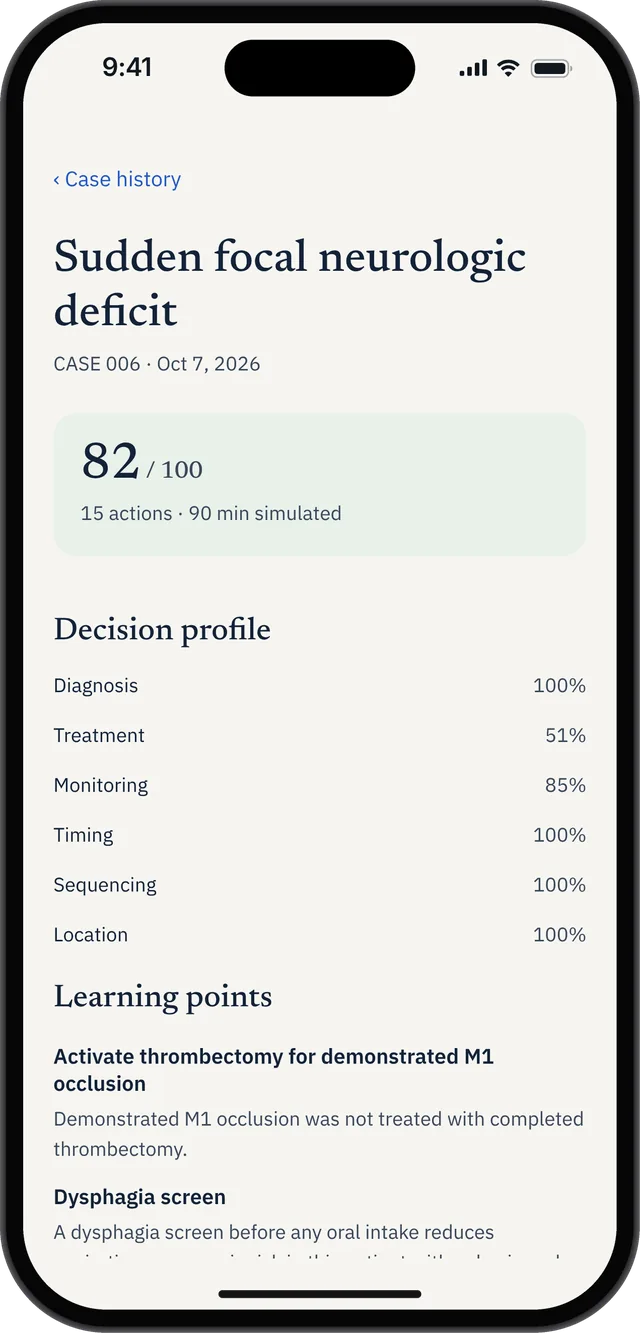
After a practice attempt, revisit its domain breakdown and learning points to choose what to improve next.
FAQ
How long is Step 3 Day 2?
Approximately nine hours, including a 5-minute optional tutorial, 180 multiple-choice items, a 6-minute CCS tutorial, 13 to 14 case simulations, and a minimum of 45 minutes of break time.
How many CCS cases are on Day 2?
13 to 14 case simulations, each allotted a maximum of 10 or 20 minutes of real time. A case may also end before its allocation, when you have demonstrated your skills sufficiently or when simulated time runs out.
Do the CCS cases come before or after the multiple-choice blocks?
After. The USMLE describes Day 2 as beginning with an optional tutorial and the multiple-choice items, then a 6-minute CCS tutorial, followed by the case simulations. Plan your break time accordingly — the cases arrive at the end of a nine-hour day.
How many MCQ blocks are there on Day 2?
For exams beginning on or after March 10, 2026, Day 2 contains nine 30-minute MCQ blocks of 20 items. The previous format had six 45-minute blocks. The total remains 180 questions over 270 minutes; CCS remains 13–14 cases with 10- or 20-minute maximums.
Is Day 2 harder than Day 1?
They are hard in different ways. Day 1 is longer on multiple-choice volume and breadth; Day 2 is a longer session that adds an interactive management format at the end. Candidates who find Day 2 harder usually say so because of the case simulations and the fatigue, not the questions.
How much break time do I get on Day 2?
A minimum of 45 minutes, which covers authorized breaks and computer transitions between blocks. It comes from a single pool for the whole session, so time spent early is unavailable later.
Keep reading
Sources
- USMLE, Step 3 Exam Content — Day 1 and Day 2 session structure, item and block counts, tutorials, CCS case count and break time.
- USMLE, 2026 Bulletin of Information (PDF) — format and length table, page 7.
- USMLE, Computer-based Case Simulations — case mechanics and case-end restrictions.
- USMLE, How to Run a Step 3 CCS Case (video transcript, PDF) — the case start screen and the two-minute alert.
- USMLE, Common Questions: Step 3 CCS — how a case ends and non-transfer of unused time.
Exam format and policy are periodically revised. Confirm the current structure on the official USMLE website before your test date.