
10-Minute vs 20-Minute CCS Cases: How Strategy Changes
Every Step 3 CCS case carries a maximum of 10 or 20 minutes of real time — and the two lengths reward different behavior. What each one is really testing, and how to budget it.
Step 3 Day 2 pairs multiple-choice blocks with a set of computer-based case simulations, and each case comes with a maximum of either 10 or 20 minutes of real time. You are told which one you are in before you begin.
The real-time allowance helps you pace the case, but it does not determine the diagnosis, acuity or number of management steps. Use the clinical presentation to decide what must happen next.
In this article
What the time limit actually signals
The time limit is a signal about scope, not about difficulty.
A 10-minute case gives you a shorter real-time budget. Prioritize indicated actions and efficient reassessment; do not assume that every short case has a single problem or one decisive intervention.
A 20-minute case provides more real time and may involve several management phases. It can still be an emergency requiring immediate treatment.
The USMLE's own published sample cases illustrate the spread: a tension pneumothorax case is allotted 10 minutes, while cases including rheumatoid arthritis, aortic dissection, asthma, diabetic ketoacidosis and eclampsia are allotted 20.
The trap in the obvious heuristic
Read that sample list again, because it quietly demolishes the heuristic most candidates form.
The tempting shortcut is: 10 minutes means an emergency, 20 minutes means an outpatient or chronic case. It is wrong. Aortic dissection, eclampsia and diabetic ketoacidosis are among the more time-critical presentations in medicine, and all three appear as 20-minute cases.
What a 20-minute allocation tells you is that the case does not end when the immediate threat is handled — not that there is no immediate threat. A dissection case still requires prompt rate and pressure control and prompt surgical involvement. It simply also requires everything that follows.
The correct reading: the clock tells you how long the story is, not how urgent the first chapter is. Treat every acute presentation with the same urgency regardless of allocation, and let the allocation tell you how much comes afterward.
Running a 10-minute case
Ten minutes of real time is less than it sounds once you account for reading the opening vignette, typing orders and advancing the clock. The margin for hesitation is essentially zero.
Prioritize immediate threats. Choose supportive care, monitoring and treatment from the findings rather than applying an automatic oxygen-and-fluids bundle.
Choose narrow diagnostics. Order the study that changes management now. In a short case there is rarely room for a confirmatory investigation that only satisfies curiosity, and there is never room for one that delays treatment.
Choose the next reassessment point deliberately. If the next pending result is too far away for the patient’s condition, use a shorter interval.
Decide disposition early. Because location changes and follow-up appointments are locked once the case-end screen appears, and because a 10-minute case reaches that screen quickly, disposition needs to be a decision you make as soon as the patient is stable and treated — not something you get to.
Expect the case to end before you feel finished. That is normal in short cases and is not, by itself, a bad sign.
Running a 20-minute case
The longer format fails candidates in a different way. Nobody runs out of time in the first five minutes of a 20-minute case; they run out in the last five, having spent the middle section doing very little.
Do not slow the opening. Whatever is time-critical is still time-critical. Treat the first two minutes of a 20-minute case exactly as you would treat a 10-minute case.
Use the middle deliberately. The extra time exists for the phases that a short case cannot accommodate — observing the response to treatment, adjusting therapy, managing complications, moving the patient between settings as their needs change, and following the course across simulated hours or days.
Expect the setting to change. Longer cases are more likely to involve a transition — emergency department to ICU, ICU to floor, hospital to outpatient follow-up. Ask "right place?" every time you advance.
Budget for the longitudinal tail. If the case runs into follow-up visits, remember that anything that should already be true when the patient returns has to be ordered before you jump: the prescription, the counseling, the referral, the lab drawn in the interval.
Reserve the closing sweep. With more happening, there is more to forget. Vaccination, prophylaxis, counseling, adherence and follow-up all belong to the categories that get deferred, and a 20-minute case gives you more opportunities to defer them.
| 10-minute case | 20-minute case | |
|---|---|---|
| Typical shape | One dominant problem, one decisive intervention | Multi-phase course, evolving state, sometimes longitudinal |
| Diagnostics | Narrow, decision-changing only | Focused, but room for a staged work-up |
| Clock advancement | Mostly next-available-result | Mixed: short intervals early, longer jumps later |
| Location | Often one setting | Transitions are common |
| Biggest risk | Hesitation in the opening | Coasting through the middle |
| Feels like | A resuscitation | A hospital course |
Why cases end early
A CCS case ends when you have "demonstrated your skills sufficiently" or when you have run out of real or simulated time. Both endings are normal.
An early ending does not establish whether your management was correct. Review practice feedback for evidence of missed or completed care rather than interpreting the ending itself as a score.
It is worth internalizing this because the alternative interpretation causes real harm on test day. A candidate who believes an early ending signals failure will carry that anxiety into the next case, and anxiety in the next case costs far more than an early ending in the last one.
The reverse is also true: filling the full allocation is not evidence of a good case. Time used is not a proxy for management quality.
Unused time does not carry over
One structural detail worth knowing: real-time allocations vary by case, and time you do not use on one case does not transfer to the next.
Two practical conclusions follow.
Do not rush past indicated care. Unused time does not extend a later case’s individual limit, although it can increase available break time.
There is no rescue for overspending, either. A case where you burned four minutes deciding between two reasonable antibiotics is a case where you have four fewer minutes, permanently. This is why interface fluency matters: seconds recovered from mechanics are seconds available for judgment.
Practicing both lengths
Most people practice one length by accident. If your practice resource presents everything as an untimed case script, or as a single uniform format, you will build one rhythm and then meet two on test day.
Two things to build deliberately:
A compressed rhythm. Short cases with a real clock, run often enough that the opening set is automatic and the closing sweep starts the instant the prompt appears. This is the rhythm most candidates lack, and it is the one that benefits most from high-frequency repetition — a single focused case in a spare ten minutes is a genuinely useful unit of study.
An extended rhythm. Longer cases where you deliberately practice the middle section: reassessing after each intervention, moving the patient when their needs change, and managing an interval course rather than a single moment.
Practice both rhythms
Timed cases in both formats, on a phone
At launch, CCS Orbit will offer 120+ cases with both ten-minute and twenty-minute real-time budgets. The Quick 10 shortcut helps you find a shorter case, and Save & exit lets you resume a case with its simulation state intact when your day is interrupted.
Each attempt is reviewed across diagnosis, treatment, monitoring, timing, sequencing and location. The debrief connects feedback to missed, late or out-of-sequence decisions, helping you choose what to practice next across the 120+ case library.
Three cases are free. Orbit Plus offers a 60-day Exam Pass for US$34.99 or lifetime access for US$59.99. These are the only two paid options. Both are one-time purchases with no automatic renewal or monthly subscription. Regional prices and applicable taxes appear in the App Store purchase sheet. See Orbit Plus options.
Available on the App Store soon. Get one email at launch →
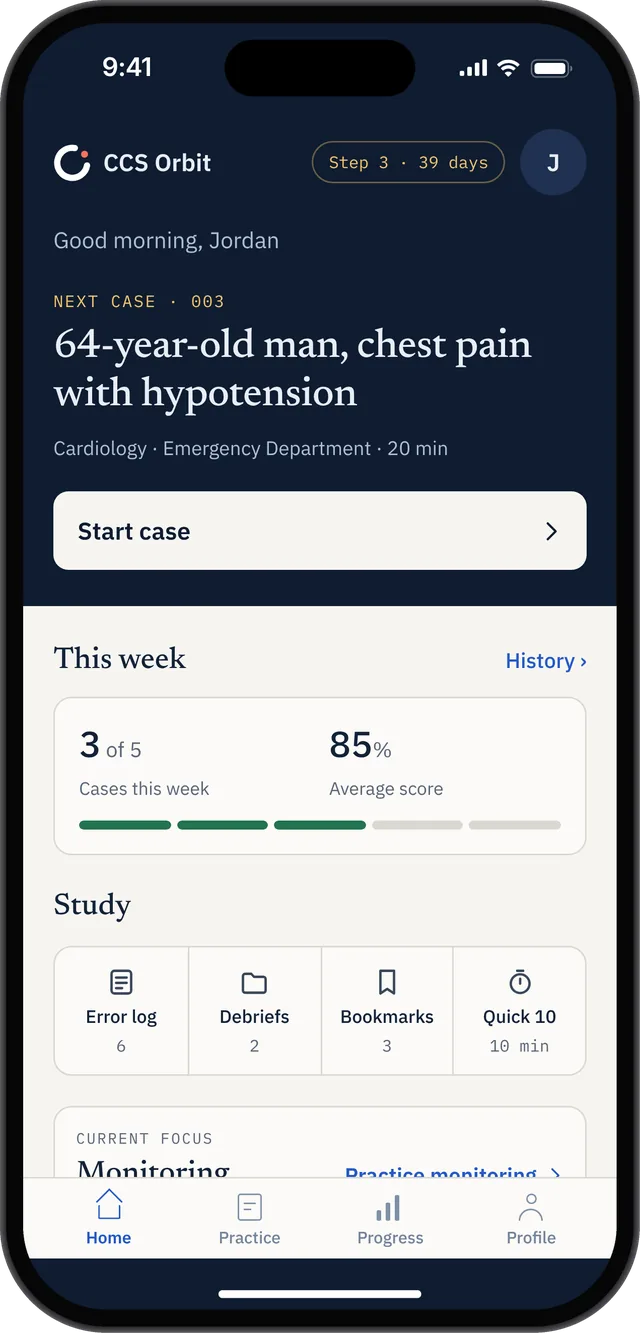
Home shows a case preview and its length, plus study shortcuts for shorter review sessions.
FAQ
How long is each CCS case on Step 3?
Each case is allotted a maximum of either 10 or 20 minutes of real time, and you may not need the entire allocation. Simulated time within a case is separate and can span from a few minutes to several weeks.
Do I know the time limit before starting a case?
Yes — the allocation is shown with the case, and the USMLE's published sample cases are labeled with their time limits. Use it to plan scope, not urgency.
My case ended at eight minutes of a twenty-minute allocation. Did I fail it?
An early ending is not a reliable indicator of success or failure. Cases can end for different reasons, so use the available practice feedback to assess your management.
Are 20-minute cases harder than 10-minute cases?
The allowance does not reliably indicate difficulty or acuity. Official 20-minute samples include emergencies such as aortic dissection and eclampsia, while the tension pneumothorax sample allows 10 minutes.
Should I try to finish early to save time?
Do not end a case with indicated management unfinished. Unused time cannot extend another case, although it can add to available break time.
How many CCS cases are on the exam?
Step 3 Day 2 (Advanced Clinical Medicine) includes multiple-choice blocks plus a set of case simulations, with the CCS portion consisting of roughly 13 to 14 cases in the current published structure. Confirm the current format on the official USMLE website before your test date, as exam structure is periodically updated.
Keep reading
Sources
- USMLE, Step 3 Exam Content — Day 2 structure, number of case simulations and per-case real-time limits.
- USMLE, Computer-based Case Simulations — sample cases with their 10- and 20-minute allocations, real versus simulated time, case-end restrictions.
- USMLE, Common Questions: Step 3 CCS — how a case ends and non-transfer of unused time.
- USMLE, How to Run a Step 3 CCS Case (video transcript, PDF) — the two-minute real-time alert.