
The Best CCSCases Alternatives for Step 3 in 2026
Compare CCSCases alternatives for Step 3, including CCS Orbit’s affordable iPhone practice, offline cases and targeted feedback. See costs and practical differences.
CCSCases advertises 180+ cases, browser access across devices, and case grading. If you are comparing alternatives, consider the access cost, your preferred device and how the feedback helps you improve the next attempt.
People still look for alternatives, and usually for practical reasons rather than complaints: a subscription model built on fixed time windows that has to line up with a study schedule, a preference for a different feedback style, wanting something that fits into short gaps in a working week, or simply wanting to compare before committing.
This is a survey of the realistic options in 2026, what each is actually good at, and where each one falls short. Prices and case counts change — verify current details on each provider's own site before buying.
In this article
Start with the free official cases
Before paying anyone, use the material the exam's own administrators publish.
The USMLE provides practice through its interactive testing experience, which includes the opportunity to practice with six CCS cases and receive case-related feedback, alongside a CCS tutorial and published sample cases with their real-time allocations. The Step 3 materials also include a walkthrough of how to run a case.
Best for: interface familiarity — which is the single thing no third-party product can fully replicate. Every commercial simulator approximates the official software; the official practice cases are it.
Limitations: six cases is not a study program. It is orientation, and it is meant to be.
If you do nothing else on this list, do this. Candidates lose real-time budget on test day to unfamiliarity with the order entry and navigation, and that is entirely preventable at zero cost.
Cost: free.
CCS Orbit
What it is: A Step 3 CCS practice app designed for iPhone. Cases are interactive simulations: choose investigations, treatment, monitoring and disposition, advance the clock and respond as the patient changes, then review a structured debrief. The launch library contains 120+ cases, including three complete free cases. The app is available on the App Store soon.
CCS Orbit combines full patient-management cases with an iPhone workflow. Practice diagnosis, treatment, monitoring, timing, sequencing and location, then review specific missed or delayed decisions. Save & exit preserves an interrupted case, while offline cases and debriefs make study practical without a reliable connection.
Best for: candidates who want affordable, focused CCS practice on iPhone, with a full case library and learning tools that connect one attempt to the next.
Availability and exam preparation: CCS Orbit is coming soon to the App Store and is designed for iPhone. Its 120+ cases provide a focused CCS practice library. Use the free official USMLE software alongside Orbit to learn the examination interface; a second paid case bank is not required to use Orbit.
Cost: Three cases are free. Orbit Plus offers a 60-day Exam Pass for US$34.99 or lifetime access for US$59.99. These are the only two paid options. Both are one-time purchases with no automatic renewal or monthly subscription. Regional prices and applicable taxes appear in the App Store purchase sheet. See Orbit Plus options.
UWorld Step 3 CCS
UWorld includes CCS in its broader Step 3 preparation bundle. For focused CCS practice, compare the bundle price with a dedicated resource such as CCS Orbit.
What it is: a CCS case library — over 90 cases at the time of writing, described as 40+ classic CCS cases across specialties plus 50+ interactive cases mirroring commonly tested scenarios. It uses free-text order entry designed to resemble the actual exam interface, and it is accessible through the UWorld Medical app as well as on desktop.
Best for: candidates who need a Step 3 question bank as part of the same purchase.
Limitations: it is a bundle. At the time of writing, UWorld's Step 3 packages that include CCS start at $449 for 90 days of QBank and CCS access, rising for longer or biostatistics-inclusive plans. If you already have a question bank you are happy with, you are paying for it twice.
Cost: bundled subscription; check UWorld for current pricing.
AMBOSS Step 3
What it is: a question bank and clinical knowledge library rather than a case simulator. AMBOSS's Step 3 product includes patient-based clinical scenarios described as mirroring the management reasoning required in the CCS portion, alongside 2,250+ practice questions, a score predictor, biostatistics coverage and a mobile app.
Best for: candidates looking for a question bank with linked clinical reference material. Dedicated simulated case management is a different task.
Limitations: CCS-style reasoning practice is not the same as running a timed simulation with a clock, an order sheet and a case-end prompt. Treat it as complementary to a simulator, not as one.
Cost: Step 3 memberships in the $298–$448 range at the time of writing, depending on access duration.
Archer's CCS workshop
Archer offers a recorded CCS teaching course with approximately 35 hours across six streaming videos, plus strategy materials. Check its course page for current prices and access periods.
Format: recorded teaching for learners who want an introductory walkthrough. Follow any demonstration with your own case attempts and feedback review.
Limitations: you are watching, not doing. Interface fluency and clock discipline are motor skills, and they are not acquired passively. Pair it with hands-on practice.
Cost: check Archer’s current course page for prices and access periods.
Print and text-based case reviews
Long-standing print titles cover CCS case scripts and management outlines, and dedicated Step 3 review books include CCS chapters. They are inexpensive, portable and good for building the pattern library of "what does this presentation need."
Limitations: editions age, and case scripts cannot teach timing. A book cannot interrupt you at two minutes remaining, and that interruption is a substantial part of what makes CCS difficult.
Newer web simulators: read the fine print
A number of newer web-based CCS simulators have appeared, several of them marketing heavily on comparison and "alternatives" search terms. Some are genuinely useful. Others are thin.
A short due-diligence list before paying anyone:
- Can you try real cases free, without a card? A meaningful trial is the clearest signal of confidence in the product.
- Who wrote and reviewed the clinical content? Look for a stated review process, not just a case count.
- Is the feedback specific? "You scored 72" is not feedback. "You treated correctly but never reassessed, and the disposition was late" is.
- What happens to your subscription time? Fixed-window subscriptions can expire during a schedule change; check the refund and extension policy before buying. CCSCases, for example, states that subscriptions begin at purchase and that there are no refunds for unused time.
- Does the case count survive contact with the library? Distinct, fully developed cases are worth more than a large number of variations on a few templates.
How to choose
| If your situation is... | Start with |
|---|---|
| You have not touched the software yet | The free official practice cases |
| You want maximum case volume in one place | CCSCases or UWorld |
| You are already buying a Step 3 question bank | UWorld's bundled CCS |
| Your problem is finding time to practice at all | A mobile-first option such as CCS Orbit |
| Your problem is the reasoning, not the mechanics | AMBOSS, or a print case review |
| You learn best by watching an expert first | Archer's CCS workshop |
| You have limited budget | Official software + Orbit’s three free cases; US$34.99 Exam Pass for the full library |
Start with the free official software for interface familiarity, then choose a paid CCS resource that fits your budget and practice routine. Orbit brings 120+ full cases, offline iPhone access and targeted review into one focused purchase.
The frequency piece
Full case practice that fits your day
CCS Orbit brings the full management-and-review loop to iPhone: manage a patient, review the response and use the debrief to decide what to improve. The Decision Profile, Error Log and Focus Mode help connect your case attempts into a practice plan.
It has 120+ cases at launch across the major presentation categories and tracks progress across six management domains. In the case-end period, you can review the chart, cancel active orders and place final orders, so closing decisions get rehearsed as deliberately as opening ones. Three complete cases are free to try.
Three cases are free. Orbit Plus offers a 60-day Exam Pass for US$34.99 or lifetime access for US$59.99. These are the only two paid options. Both are one-time purchases with no automatic renewal or monthly subscription. Regional prices and applicable taxes appear in the App Store purchase sheet. See Orbit Plus options.
Available on the App Store soon. Get one email at launch →
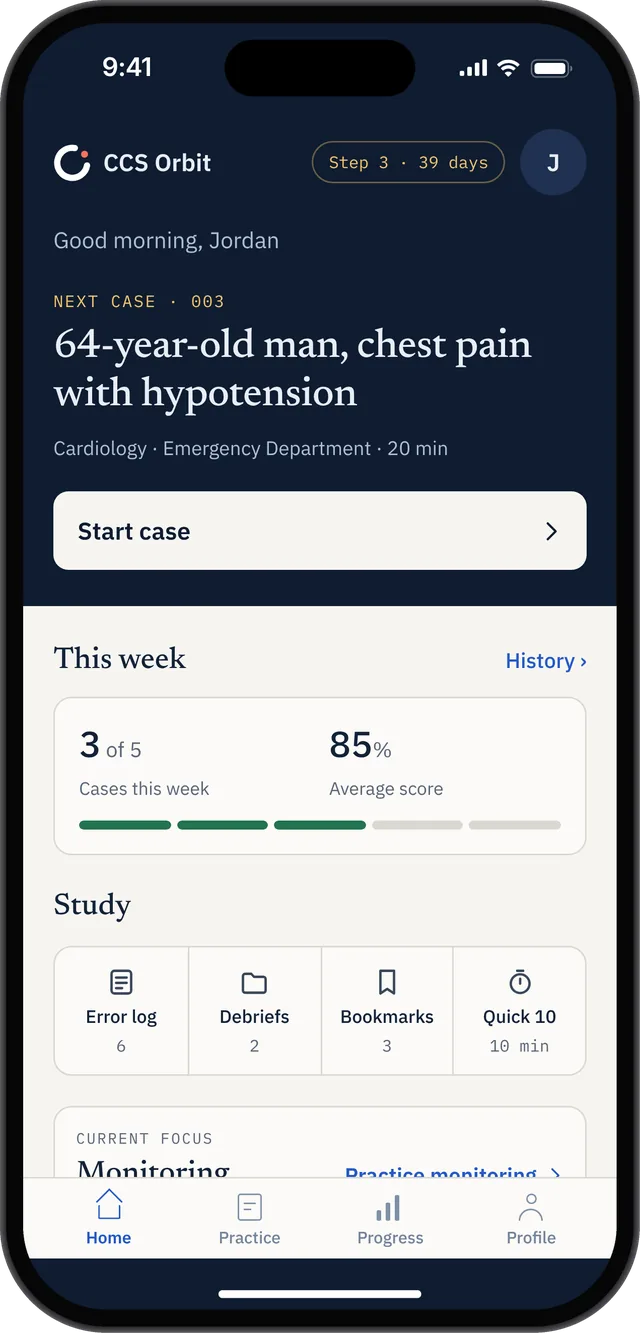
Start a case or return to debriefs and study tools from Home. Offline access makes that routine easier to fit around your day.
What no alternative can offer
One claim to be skeptical of, whoever makes it: that a practice score predicts your official result.
The USMLE's scoring methodology for CCS is proprietary and is not published. Every third-party score — including CCS Orbit's — is a training signal generated by that product's own rubric. Useful for tracking whether you are improving, useful for finding your weak domains, and not an estimate of a Step 3 outcome.
CCS Orbit is independent of the USMLE program, FSMB and NBME. Commercial practice scores use each provider’s own criteria; verify affiliation claims with the relevant organization and do not use recalled secure exam content.
Use the official material to learn the exam controls and your chosen case library to practice management. Orbit combines case breadth, convenient offline access and feedback you can act on, with a US$34.99 Exam Pass or US$59.99 lifetime option.
FAQ
Is there a free alternative to CCSCases?
The USMLE’s interactive testing experience lets you practice six CCS cases with case-related feedback at no cost, and publishes sample cases and a tutorial. Some commercial products offer trial or free cases; CCS Orbit will include three complete free cases at launch. Official cases plus a free tier are a genuine starting point, though not a full study program.
How many CCS cases do I need to practice?
There is no official number. A more useful benchmark than case count is whether the mechanics have become automatic — the opening set, the advance-and-reassess loop, and the closing sweep — and whether you can name the two workflow habits that keep costing you points.
Is UWorld's CCS worth it if I already have a question bank?
UWorld sells CCS as part of a bundle with its Step 3 question bank, so if you already own a bank you are effectively paying twice. In that case a standalone CCS resource is usually the more economical route. If you have not yet bought a question bank, the bundle may be the better value.
Can any app tell me what I would score on the real CCS?
No. The USMLE does not publish its CCS scoring algorithm, so every third-party score is that product's own training metric. Use practice scores to track your own trend and identify weak domains, not to predict an exam result.
Are mobile CCS apps good enough on their own?
A phone is excellent for frequency, repetition and reviewing your own errors, and it is where most candidates can realistically fit practice into a working week. It is not a substitute for practicing on the official software, because interface fluency has to be built where the interface actually is. Use both.
Keep reading
For a focused price and feature comparison, read CCS Orbit vs CCSCases.
Sources
- USMLE, Common Questions: Step 3 CCS — practice with six CCS cases and case-related feedback.
- USMLE, Computer-based Case Simulations — sample cases, tutorial and case mechanics.
- CCSCases.com and its purchase page — advertised case count, device support, feedback and subscription terms.
- UWorld USMLE Step 3 — CCS case counts, free-text order entry, app access and package pricing.
- AMBOSS Step 3 — CCS-style clinical scenarios and membership pricing.
- Archer Review CCS Cases — video workshop format, duration and price.
Third-party product details were accurate at the time of writing and change frequently. Verify current case counts, features and pricing with each provider.